
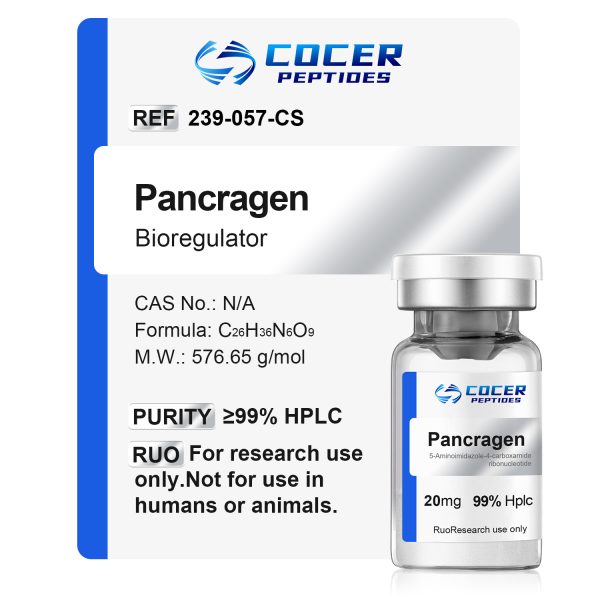
Pancragen 20mg
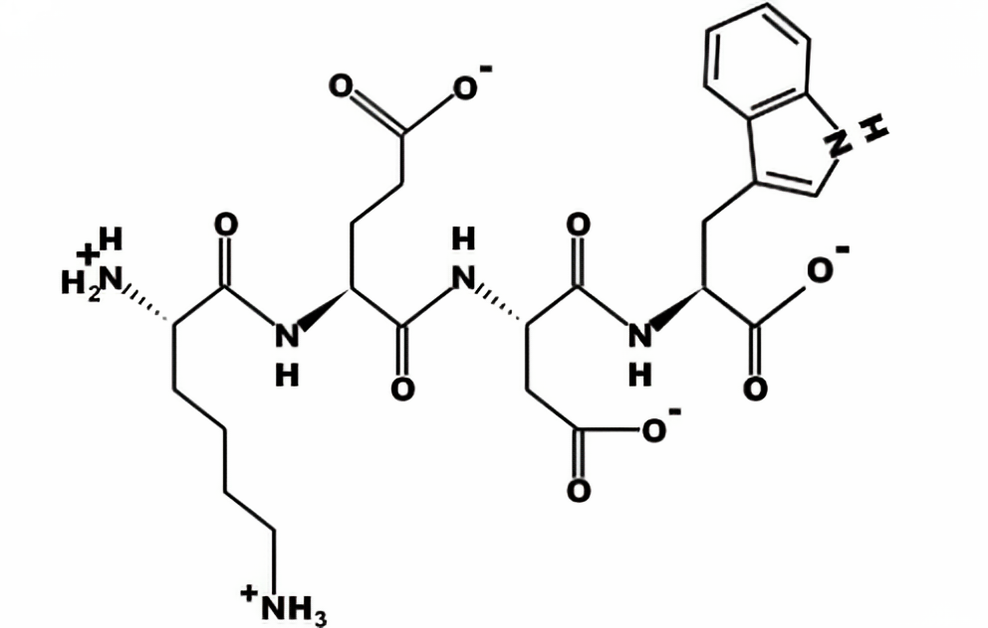
Pancragen is a synthetic linear tetrapeptide composed of four amino acid residues—L-lysine, L-glutamic acid, L-aspartic acid, and L-tryptophan—arranged in the sequence Lys-Glu-Asp-Trp (KEDW), with a molecular formula of C₂₆H₃₆N₆O₉ in its free-acid form. Supplied as a lyophilized powder for laboratory research and analytical use only. Not intended for human or veterinary use, including consumption, injection, topical application, or any diagnostic, therapeutic, or clinical purpose.
Certificate of Analysis (COA)
Click “Check the COA” in the product section above to access the available Certificate of Analysis for this product. Please refer to the report for batch information and analytical results.
For laboratory research use only. Not for human or veterinary use.
Pancragen Structure
 PepDraw
- Sequence:Lys-Glu-Asp-Trp (KEDW)
- Molecular Formula:C26H36N6O9
- Molecular Weight:576.65g/mol
- PubChem CID:68452887
Pancragen Research
Molecular Background
Pancragen is a synthetic tetrapeptide commonly described in the cited literature as H-Lys-Glu-Asp-Trp-NH2 (KEDW-NH2). PubChem lists this amidated KEDW sequence under CID 68451868, with the molecular formula C26H37N7O8 and a molecular weight of approximately 575.6 g/mol.[7]
Research Progress
V. Kh. Khavinson and colleagues examined Pancragen in cultured pancreatic cells at different stages of cellular ageing. The investigators measured transcription factors associated with acinar-cell and islet-cell differentiation. They reported lower expression of several differentiation markers in aged cultures and higher expression of Pdx1 and Ptf1a in acinar-cell cultures and Pdx1, Pax6, Pax4, Foxa2, and Nkx2.2 in islet-cell cultures after Pancragen exposure. These findings were obtained in cultured pancreatic cells and describe changes in marker expression under the experimental conditions used; they do not establish clinical effects.[1]
Fig. 1. Ptf1a expression in pancreatic cell cultures reported in the cited study.[1]
The source figure compares immunocytochemical Ptf1a staining in control cultures and cultures exposed to bronchogen or Pancragen. Magnification and complete experimental conditions are reported in the original publication.[1]
N. D. Goncharova and colleagues compared Pancragen with glimepiride in nine clinically healthy old female rhesus monkeys aged 20-25 years. Five animals received Pancragen at 0.05 mg per animal per day by intramuscular administration for 10 days, while four animals received glimepiride orally for the same period. Glucose, insulin, and C-peptide were measured before, during, and after treatment under basal conditions and during glucose-tolerance testing. The authors reported lower basal blood-glucose measurements in both study groups and changes in insulin and C-peptide dynamics in the Pancragen group. Because the study included only nine non-human primates and did not include an untreated age-matched control group, its findings should remain limited to the experimental design reported.[2]
V. Kh. Khavinson and colleagues studied Pancragen in Wistar rats with streptozotocin-induced experimental diabetes. The investigators measured blood glucose together with mesenteric-capillary permeability and endothelial adhesion after oral or intramuscular exposure. The authors reported lower blood-glucose measurements during oral exposure and changes in mesenteric-capillary endothelial adhesion after intramuscular exposure, while capillary permeability was not significantly altered. These observations were obtained in a chemically induced rat model and should not be extrapolated to human diabetes or vascular outcomes.[3]
V. Kh. Khavinson and colleagues evaluated short peptides in cultured human embryonic pancreatic and bronchial cells and in human prostatic fibroblasts. Late-passage cultures showed lower expression of selected differentiation-related markers. Pancragen (KEDW-NH2) was associated with higher CXCL12 and Hoxa3 expression in pancreatic-cell cultures, whereas bronchogen and vesugen were examined in the corresponding bronchial and prostatic cell systems. The study therefore supports a tissue-specific change in differentiation-marker expression in vitro rather than a systemic or clinical effect of Pancragen.[4]
In a related non-human primate study, N. D. Goncharova and colleagues examined endocrine-pancreatic measurements in old female rhesus monkeys before, during, and after a 10-day course of Pancragen. The authors reported differences in the rate of glucose disappearance and in plasma insulin and C-peptide responses during glucose-tolerance testing, with some measurements remaining different several weeks after the intervention. These observations were obtained in aged rhesus monkeys and do not establish efficacy, safety, or dosing parameters in humans.[5]
A. N. Zakutskii and colleagues compared several short synthetic peptides in organotypic explant cultures from heart, lung, prostate, and pancreas tissues obtained from young and aged rats. Pancragen was examined in the pancreatic explant system. At the concentration reported in the study (0.05 ng/mL), the authors observed increased growth of the corresponding tissue explants compared with control cultures. Because this was an organotypic tissue-culture experiment, the result does not establish whole-animal pharmacology or clinical performance.[6]
Research Limitations
The cited Pancragen literature is composed primarily of pancreatic cell cultures, organotypic rat tissue cultures, a streptozotocin-induced rat model, and small studies in aged rhesus monkeys. These experimental systems answer different research questions and are not directly interchangeable. The two rhesus-monkey reports involved small cohorts, and much of the published work comes from overlapping research groups, which limits independent replication. The cited studies also do not provide a systematic characterization of human pharmacokinetics, bioavailability, long-term safety, or dose-response relationships for an independently supplied Pancragen research material.[1-6]
A further limitation is chemical-form identification. The experimental literature and PubChem record cited here describe the amidated tetrapeptide H-Lys-Glu-Asp-Trp-NH2 (KEDW-NH2).[2-5,7] Results should not be automatically transferred to a free-acid KEDW material or to products whose identity, purity, formulation, or manufacturing controls differ from those used in the cited experiments. FDA has also repeatedly stated in research-peptide warning letters that a “research use only” disclaimer does not override website language that establishes an intended human drug use through disease-treatment or body-structure/function claims.[8]
COCER Peptides presents Pancragen solely for laboratory research and analytical use. It is not intended for human or veterinary use. This COCER Peptides material is not an FDA-approved drug product. The research described above summarizes findings reported in third-party publications and is not a statement of clinical efficacy, safety, diagnosis, treatment, prevention, glucose control, pancreatic restoration, or an instruction for use.
Relevant Citations
References
[1] Khavinson V K, Durnova A O, Polyakova V O, et al. Effects of Pancragen on the differentiation of pancreatic cells during their ageing[J]. Bulletin of Experimental Biology and Medicine, 2013,154(4):501-504.
DOI:10.1007/s10517-013-1987-6.
[2] Goncharova N D, Ivanova L G, Oganyan T E, et al. Correction of impaired glucose tolerance using tetrapeptide (Pancragen) in old female rhesus monkeys[J]. Advances in Gerontology, 2015,28(3):579-585.
PMID:28509500
[3] Khavinson V K, Gavrisheva N A, Malinin V V, et al. Effect of Pancragen on blood glucose level, capillary permeability and adhesion in rats with experimental diabetes mellitus[J]. Bulletin of Experimental Biology and Medicine, 2007,144(4):559-562.
DOI:10.1007/s10517-007-0377-3.
[4] Khavinson V K, Linkova N S, Polyakova V O, et al. Peptides tissue-specifically stimulate cell differentiation during their aging[J]. Bulletin of Experimental Biology and Medicine, 2012,153(1):148-151.
DOI:10.1007/s10517-012-1664-1.
[5] Goncharova N D, Ivanova L G, Oganian T E, et al. Impact of tetrapeptide Pancragen on endocrine function of the pancreas in old monkeys[J]. Advances in Gerontology, 2014,27(4):662-667.
PMID:25946840
[6] Zakutskii A N, Chalisova N I, Ryzhak G A, et al. The tissue-specific effect of synthetic peptides-biologic regulators in organotypic tissue culture in young and old rats[J]. Advances in Gerontology, 2006,19:93-96.
PMID:17152728
[7] NCBI PubChem. H-Lys-Glu-Asp-Trp-NH2. PubChem CID 68451868.
[8] U.S. Food and Drug Administration. Peptide Partners LLC, Warning Letter 735063, August 24, 2026.
ALL PRODUCTS, ARTICLES, TECHNICAL MATERIALS, PRODUCT DESCRIPTIONS, AND OTHER INFORMATION PROVIDED ON THIS WEBSITE ARE INTENDED SOLELY FOR LEGITIMATE LABORATORY RESEARCH, INFORMATIONAL, AND EDUCATIONAL PURPOSES.
Products offered by Cocer Peptides are intended exclusively for in vitro and laboratory research and are NOT intended for human or veterinary use, human consumption, clinical use, diagnostic use, therapeutic use, compounding, self-administration, injection, or any other form of administration to humans or animals. These products are not intended to diagnose, treat, cure, mitigate, or prevent any disease or medical condition, nor are they intended to affect the structure or function of the human or animal body. Unless expressly stated otherwise, products offered on this website have not been evaluated or approved by the U.S. Food and Drug Administration (FDA) for human or veterinary use. Any references to published studies, biochemical pathways, molecular mechanisms, or experimental findings are provided solely for scientific discussion and research purposes and do not constitute medical advice, therapeutic claims, dosing guidance, or instructions for use. Purchasers are solely responsible for ensuring that all products are acquired, handled, stored, used, and disposed of in accordance with applicable laws, regulations, institutional requirements, and laboratory safety standards.