
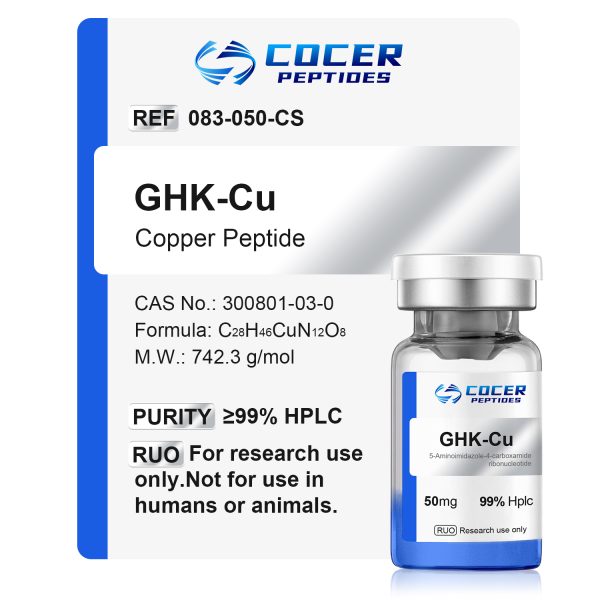
GHK CU 50mg
GHK-Cu is a copper-binding tripeptide complex widely studied in biochemical and cellular research. Supplied as a lyophilized powder for laboratory research and analytical use only. Not intended for human or veterinary use, including consumption, injection, topical application, or any diagnostic, therapeutic, or clinical purpose.
▎What is GHK CU?
GHK CU is a complex formed by the binding of a tripeptide—composed of glycine (Gly), histidine (His), and lysine (Lys) linked by peptide bonds—to divalent copper ions (Cu²⁺). Within its chemical structure, the imidazole ring of the histidine residue forms a stable coordinate bond with the copper ion, creating a coordination compound with a specific spatial conformation and biological activity.
GHK CU Structure
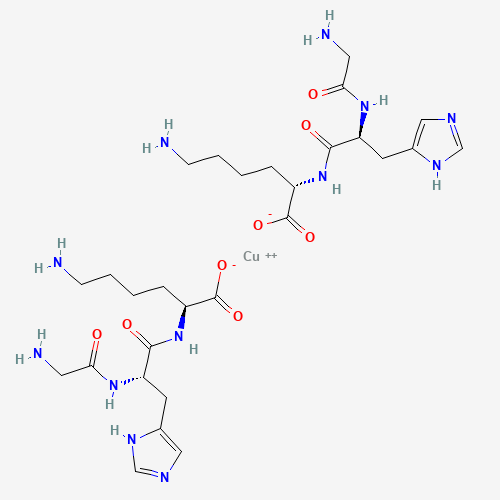 PubChem
- Sequence:Gly-His-Lys
- Molecular Formula:C28H46CuN12O8
- Molecular Weight:742.3g/mol
- CAS Number:130120-56-8
- PubChem CID:9831891
GHK CU Research
GHK-Cu is a copper-binding tripeptide complex widely studied in biochemical and cellular research. Supplied as a lyophilized powder for laboratory research and analytical use only. Not intended for human or veterinary use, including consumption, injection, topical application, or any diagnostic, therapeutic, or clinical purpose.
▎What is GHK CU?
GHK CU is a complex formed by the binding of a tripeptide—composed of glycine (Gly), histidine (His), and lysine (Lys) linked by peptide bonds—to divalent copper ions (Cu²⁺). Within its chemical structure, the imidazole ring of the histidine residue forms a stable coordinate bond with the copper ion, creating a coordination compound with a specific spatial conformation and biological activity.
Relevant Citations
References
[1] Mateescu D, Gavrilescu D, Mincioaga R, et al. GHK-Cu as a Bioactive Metallopeptide and Drug-Delivery Cargo: Coordination Chemistry, Formulation Science, Therapeutic Evidence, and a Translational Roadmap[J]. Pharmaceutics, 2026,18(9):1077.
DOI:10.3390/pharmaceutics18091077.
[2] Maquart F, Bellon G, Chaqour B, et al. In vivo stimulation of connective tissue accumulation by the tripeptide-copper complex glycyl-L-histidyl-L-lysine-Cu2+ in rat experimental wounds.[J]. The Journal of clinical investigation, 1993,92(5):2368-2376.
DOI:10.1172/JCI116842
[3] Abdulghani A A, Sherr A, Shirin S, et al. Effects of topical creams containing vitamin C, a copper-binding peptide cream and melatonin compared with tretinoin on the ultrastructure of normal skin[J]. Disease Management and Clinical Outcomes, 1998,1(4):136-141.
DOI:10.1016/s1088-3371(98)00011-4
[4] Hostynek J J, Dreher F, Maibach H I. Human skin penetration of a copper tripeptide in vitro as a function of skin layer[J]. Inflammation Research, 2011,60(1):79-86.
DOI:10.1007/s00011-010-0238-9
[5] Park S I, An G M, Kim M G, et al. Enhancement of skin permeation of anti-wrinkle peptide GHKs using cell penetrating peptides[J]. Korean Chemical Engineering Research, 2020,58(1):29-35.
DOI: 10.9713/kcer.2020.58.1.29
[6] Chen S, Lei M, Liu P, et al. Gelatin-oxidized dextran Schiff base hydrogel with MXene@TiO₂ and GHK-Cu: A multifunctional dressing for photothermal-antibacterial and pro-angiogenic wound repair[J]. Colloids and Surfaces A: Physicochemical and Engineering Aspects, 2026,751:141621.
DOI:https://doi.org/10.1016/j.colsurfa.2026.141621.
[7] Jeon S, Maeng J, Lee J, et al. A Torilis japonica Extract–GHK-Cu Complex Attenuates Th2 Cytokines and Promotes Keratinocyte Recovery: A Potential Antioxidant Strategy for Atopic Dermatitis[J]. Antioxidants, 2026,15(7):818.
DOI:10.3390/antiox15070818.
[8] Tucker M, Liao G Y, Keely A, et al. Behavioral and neuropathological features of Alzheimer’s disease are attenuated in 5xFAD mice treated with intranasal GHK peptide[J]. Aging Pathobiology and Therapeutics, 2024, 6(3):102-108.
DOI:10.31491/APT.2024.09.148.
[9] Tucker M, Keely A, Park J Y, et al. Intranasal GHK peptide enhances resilience to cognitive decline in aging mice[J]. bioRxiv, 2023.
DOI:10.1101/2023.11.16.567423.
[10] Park J, Lee H, Kim S, et al. The tri-peptide GHK-Cu complex ameliorates lipopolysaccharide-induced acute lung injury in mice[J]. Oncotarget, 2016,7(36):58405-58417.
DOI:10.18632/oncotarget.11168.
[11] Mortazavi S M, Mohammadi Vadoud S A, Moghimi H R. Topically applied GHK as an anti-wrinkle peptide: Advantages, problems and prospective[J]. BioImpacts, 2024,15:30071.
DOI:10.34172/bi.30071.
[12] PubChem. Compound Summary for CID 73587, glycyl-L-histidyl-L-lysine. National Center for Biotechnology Information.
[13] PubChem. Compound Summary for CID 133697840, GHK-Cu. National Center for Biotechnology Information.
[14] PubChem. Compound Summary for CID 139035031, Copper tripeptide. National Center for Biotechnology Information.
ALL PRODUCTS, ARTICLES, TECHNICAL MATERIALS, PRODUCT DESCRIPTIONS, AND OTHER INFORMATION PROVIDED ON THIS WEBSITE ARE INTENDED SOLELY FOR LEGITIMATE LABORATORY RESEARCH, INFORMATIONAL, AND EDUCATIONAL PURPOSES.
Products offered by Cocer Peptides are intended exclusively for in vitro and laboratory research and are NOT intended for human or veterinary use, human consumption, clinical use, diagnostic use, therapeutic use, compounding, self-administration, injection, or any other form of administration to humans or animals. These products are not intended to diagnose, treat, cure, mitigate, or prevent any disease or medical condition, nor are they intended to affect the structure or function of the human or animal body. Unless expressly stated otherwise, products offered on this website have not been evaluated or approved by the U.S. Food and Drug Administration (FDA) for human or veterinary use. Any references to published studies, biochemical pathways, molecular mechanisms, or experimental findings are provided solely for scientific discussion and research purposes and do not constitute medical advice, therapeutic claims, dosing guidance, or instructions for use. Purchasers are solely responsible for ensuring that all products are acquired, handled, stored, used, and disposed of in accordance with applicable laws, regulations, institutional requirements, and laboratory safety standards.