
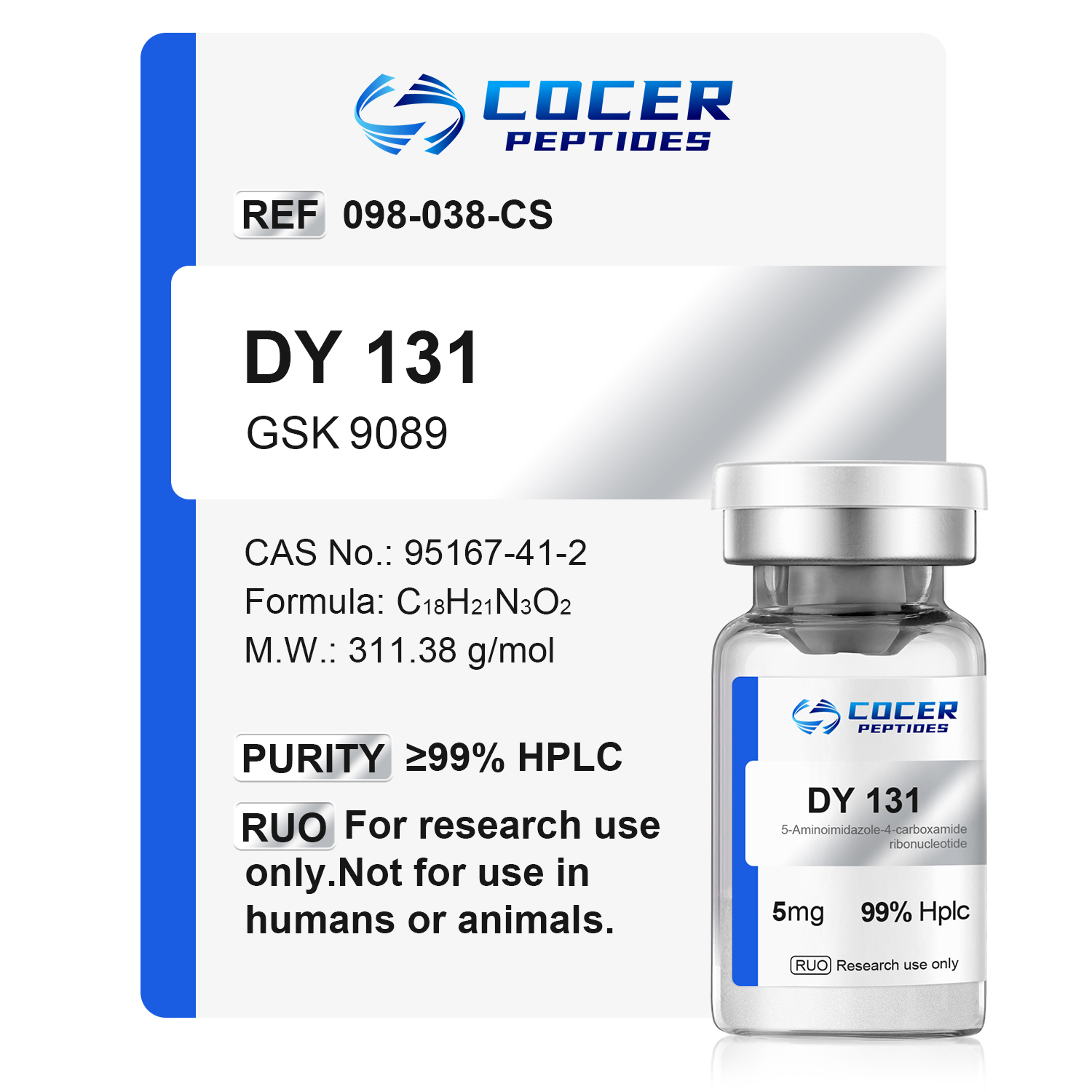
DY 131 5mg
DY131 is a small-molecule benzamide derivative and a selective estrogen-related receptor β/γ (ERRβ/γ) agonist. It exhibits no activity toward ERRα or classical estrogen receptors and also inhibits Smo signaling. Its effects are concentrated in the fields of tumor and metabolic inflammation. It inhibits the proliferation of breast and prostate cancer cells and induces G2/M phase arrest. It also improves liver injury and reduces myocardial infarction area.
The peptide will be provided as lyophilized powder to ensure maximum stability.
What is DY 131?
DY131 (also known as GSK-9089) is a small molecule compound that selectively activates the estrogen-related receptors ERRβ and ERRγ, with negligible activity toward ERRα, ERα, and ERβ. It blocks the Hedgehog signaling pathway by inhibiting the Smoothened (Smo) protein.
Certificate of Analysis (COA)
Click “Check the COA” in the product section above to access the available Certificate of Analysis for this product. Please refer to the report for batch information and analytical results.
For laboratory research use only. Not for human or veterinary use.
DY 131 Structure
- Molecular Formula:C18H21N3O2
- Molecular Weight:311.4 g/mol
- CAS Number:95167-41-2
- PubChem CID:5497124
DY 131 Research
DY 131 Research
What is the research background of DY131?Research on DY131 stems from exploring the functions of the estrogen-related receptor (ERR) family and the therapeutic need for treating tumors and metabolic diseases. As members of the nuclear receptor superfamily, ERRβ/γ share structural similarities with estrogen receptors but are activated independently of estrogen. They play crucial roles in energy metabolism, cell proliferation, and apoptosis regulation.
Researchers identified abnormal expression of ERRβ/γ in tumors and metabolic diseases, leading to the development of the selective agonist DY131. This compound targets the ERRβ/γ pathway to intervene in related pathological processes.In oncology, malignant tumors like triple-negative breast cancer (TNBC) lack effective targeted therapies. Abnormal splicing variants of ERRβ/γ (e.g., ERRβ2) have been implicated in cell cycle arrest and apoptosis.
DY131 induces G2/M phase cell cycle arrest by activating ERRβ/γ and inhibits Smo, a key protein in the Hedgehog pathway, enhancing antitumor effects through dual mechanisms. In metabolic diseases, ERRγ activation improves pathological states like liver injury and myocardial infarction by suppressing oxidative stress and inflammatory responses.What is the mechanism of action of DY131?Modulation of Estrogen-Related Receptors (ERRs)ERRγ Agonism: In a lipopolysaccharide (LPS)-induced acute liver injury model, DY131 plays a pivotal role as an agonist of estrogen-related receptor γ (ERRγ). Following LPS treatment in mice, ERRγ expression was downregulated in liver tissue, whereas DY131 pretreatment mitigated this effect.
By activating ERRγ, DY131 alleviated LPS-induced liver injury, manifested as reduced release of liver enzymes (e.g., ALT, AST, LDH), improved hepatic morphological damage, and diminished oxidative stress, inflammation, and apoptosis. This indicates that DY131 exerts hepatoprotective effects by regulating energy production, oxidative metabolism, apoptosis, and inflammatory responses through ERRγ activation[1].ERRβ/γ activation influences testicular function: In adult hamster testes, DY131—a selective agonist of ERRβ/ERRγ—was administered via intraperitoneal injection. It altered the histological structure of the interstitial tissue, increasing its volume without affecting the structure of the spermatogenic epithelium.
Ultrastructural analysis revealed alterations in mitochondrial number, as well as the volume and structure of the endoplasmic reticulum and Golgi apparatus following DY131 treatment. DY131 exerts diverse and complex regulatory effects on molecules involved in steroid synthesis and secretion at both the mRNA and protein expression levels, with these regulations being correlated with endogenous estrogen levels. This series of changes indicates that DY131 participates in maintaining the structure of testicular interstitial cells and supervising their steroid synthesis and secretion activities by activating ERRβ/γ, and is closely related to the endogenous estrogen status within the testes[2].Regulation of the Cell CycleBreast Cancer Cell Cycle Regulation: In breast cancer cell lines, DY131 inhibits cell growth and induces cell death through the p38 stress kinase pathway and bimodal cell cycle arrest.
The splice variant ERRβ2 of the estrogen-related receptor β (ERRβ) plays a crucial role, promoting G2/M phase arrest, while DY131 delays progression from prophase to anaphase. Additionally, ERRβ2 localizes to the centrosome, and DY131 induces mitotic spindle defects[3].Figure 1. DY131 alleviated the inflammatory response in LPS-treated mice.
(A,B) Serum levels of TNFα and IL-6 measured by ELISA kits (n = 10 in each group). (C–F) mRNA expressions of TNFα, IL-6, IL-1β, and NLRP3 determined by qRT-PCR (n = 10 in each group). (G) Representative images of immunohistochemical staining for IL-6 and IL-1β in liver tissues (magnification ×200, scale bar: 50 μm, n = 4–5 per group)[4].Regulation at Different Cell Cycle Stages: DY131 exhibits distinct effects on different splice variants of ERRβ.
For the short form of ERRβ (ERRβsf), DY131 mediates G1 checkpoint arrest, and ERRβsf is essential for DY131-induced cellular senescence. Conversely, ERRβ2 mediates G2/M arrest under DY131 action. In the absence of ERRβ2, DY131-induced G2/M arrest is reversed, accompanied by p21 induction and G1 arrest.
This demonstrates DY131's fine-tuned regulation of cell cycle progression through modulation of distinct ERRβ splice variants[5].Regulation of Signaling PathwaysEffects on the Hedgehog Signaling Pathway: In NIH3T3 and HEK293 cell experiments, DY131 inhibited Hedgehog pathway activity with an IC50 of 500 nM when the pathway was activated. In HEK293 cells, when the pathway was inactive, DY131 dose-dependently increased both endogenous and exogenous Gli1-induced reporter activity. Transfection of ERRβ enhanced DY131's effect on Gli reporter activity.
Western blot analysis revealed that DY131 modulates Gli1 protein levels by regulating phosphorylated Akt (a non-canonical Gli1 activator), ultimately affecting the Hedgehog signaling pathway. This demonstrates a novel regulatory mechanism of DY131 via ERRβ on the Hedgehog pathway, suggesting its potential as a new therapeutic target for Hedgehog-driven cancers[6].What are the applications of DY131?Protective effects against acute liver injury: In studies of sepsis-associated liver dysfunction, DY131 demonstrated protective effects against lipopolysaccharide (LPS)-induced acute liver injury. Ma H's research indicates that pre-treatment with DY131 administered intraperitoneally at 5mg/kg/day for three consecutive days prior to LPS challenge in mice significantly ameliorates liver injury.
Specifically, DY131 reduces the release of hepatic enzymes (such as ALT, AST, and LDH), indicating its inhibitory effect on hepatocyte damage; simultaneously improved morphological liver damage and mitigated pathological alterations in liver tissue; it also effectively alleviated oxidative stress, inflammation, and apoptosis. These combined physiological improvements collectively demonstrate DY131's protective effect against LPS-induced liver injury. Furthermore, the study found no significant adverse effects of DY131 on liver or kidney function in mice, providing a safety foundation for its potential application in acute liver injury treatment.
Transcriptomic analysis further revealed that DY131 significantly reversed inflammation- and metabolism-related dysregulated pathways in LPS-treated mice, providing stronger evidence for its protective effects [6].Cell Cycle Regulation: In studies of cell cycle regulation, DY131, as a synthetic agonist of the estrogen-related receptor β (ERRβ), plays a crucial role in regulating different splice variants of ERRβ during cell cycle control. Heckler MM et al. found that the short form ERRβ (ERRβsf) and ERRβ2 exhibit distinct effects on cell cycle regulation under DY131 influence.
ERRβsf mediates G1 checkpoint arrest via p21 and is essential for DY131-induced cellular senescence. Conversely, ERRβ2 mediates G2/M arrest upon DY131 treatment. In the absence of ERRβ2, DY131-induced G2/M arrest is reversed, accompanied by p21 induction and G1 arrest.
This precise regulation of the cell cycle provides an important research tool and potential therapeutic target for studying cell proliferation, senescence, and the pathogenesis of related diseases [5].Breast Cancer Treatment: In the field of breast cancer research, particularly regarding the treatment of triple-negative breast cancer (TNBC), DY131 holds promising potential. DY131 inhibits the growth of multiple breast cancer cell lines, inducing cell death through the p38 stress kinase pathway and bimodal cell cycle arrest. ERRβ2 contributes to G2/M phase arrest, and DY131 delays progression from prophase to anaphase.
ERRβ2 localizes to the centrosome, and DY131 induces mitotic spindle defects. This series of mechanisms suggests that targeting ERRβ2 and leveraging DY131's effects may represent a promising therapeutic strategy for breast cancer, particularly for TNBC—a subtype lacking clinically viable therapeutic targets[3].ConclusionDY131 demonstrates significant roles in acute liver injury protection and cell cycle regulation.About The AuthorThe above-mentioned materials are all researched, edited and compiled by Cocer Peptides.Scientific Journal AuthorLu Y is a researcher in the field of biomedical sciences, with expertise in molecular and cellular biology. Lu Y participates in scientific research projects and contributes to publications and academic collaborations.
Lu Y is listed in the reference of citation [6].
Relevant Citations
References
[1] Oshita A. Studies on the Mechanism of Insulin Action. 1964; 7: 39-47.DOI: 10.11213/tonyobyo1958.7.39.
[2] Pawlicki P, Milon A, Zarzycka M, et al. Does signaling of estrogen-related receptors affect structure and function of bank vole Leydig cells? Journal of Physiology and Pharmacology 2017; 68(3): 459-476.
[3] Heckler MM, Zeleke TZ, Divekar SD, et al. Antimitotic activity of DY131 and the estrogen-related receptor beta 2 (ERRβ2) splice variant in breast cancer. Oncotarget 2016; 7(30): 47201-47220.DOI: 10.18632/oncotarget.9719.
[4] Ma H, Liu J, Du Y, et al. Estrogen-Related Receptor γ Agonist DY131 Ameliorates Lipopolysaccharide-Induced Acute Liver Injury. Frontiers in Pharmacology 2021; 12: 626166.DOI: 10.3389/fphar.2021.626166.
[5] Heckler MM, Riggins RB. ERRβ splice variants differentially regulate cell cycle progression. Cell Cycle 2015; 14(1): 31-45.DOI: 10.4161/15384101.2014.972886.
[6] Lu Y, Merideth BR, Lin H, Lubahn DB. Abstract 1308: ERR$beta$ ligand DY131 regulation of the hedgehog signaling pathway by modulation of Akt phosphorylation. Cancer Research 2013; 73: 1308. ALL ARTICLES AND PRODUCT INFORMATION PROVIDED ON THIS WEBSITE ARE SOLELY FOR INFORMATION DISSEMINATION AND EDUCATIONAL PURPOSES. The products provided on this website are intended exclusively for in vitro research. In vitro research (Latin: *in glass*, meaning in glassware) is conducted outside the human body. These products are not pharmaceuticals, have not been approved by the U.S. Food and Drug Administration (FDA), and must not be used to prevent, treat, or cure any medical condition, disease, or ailment. It is strictly prohibited by law to introduce these products into the human or animal body in any form.