
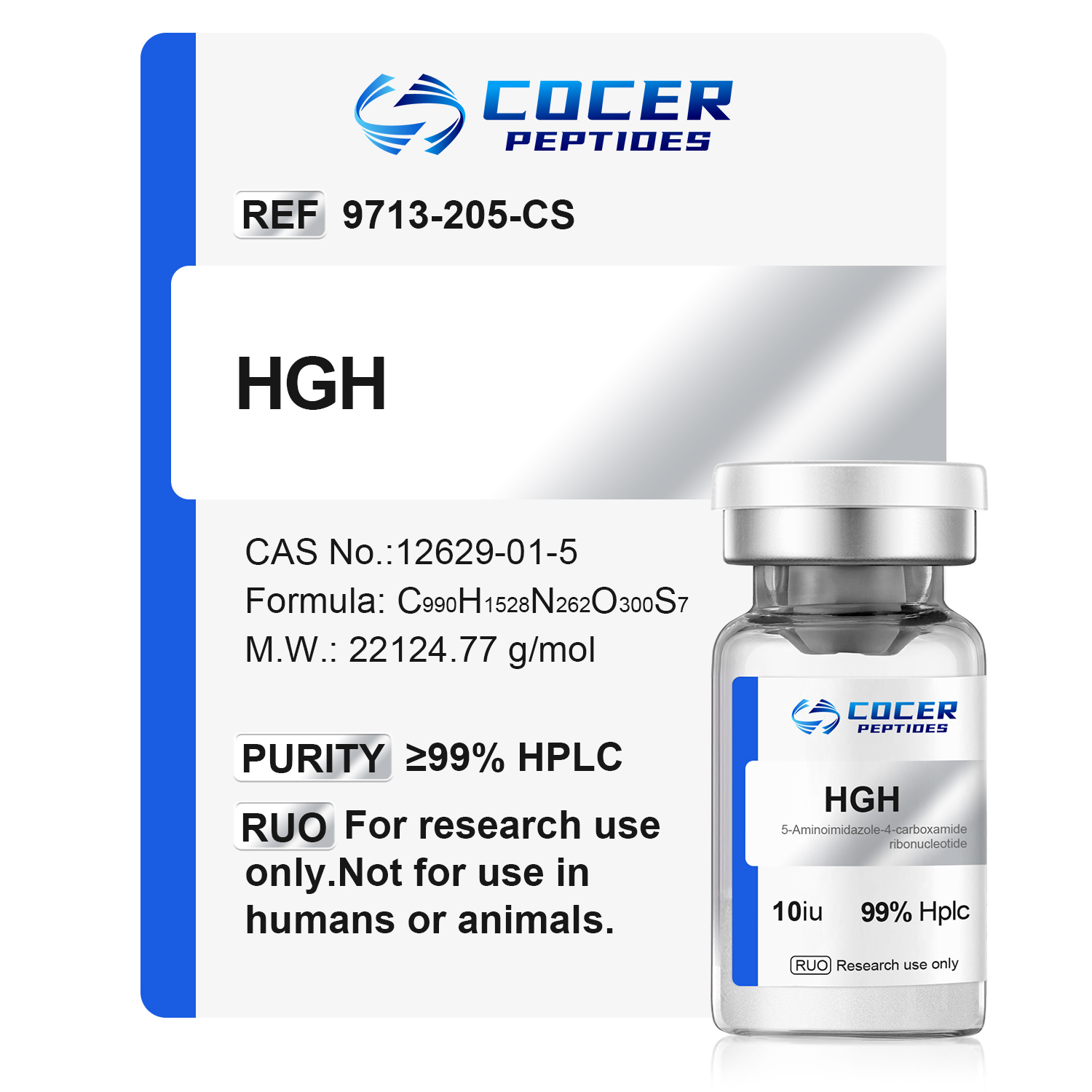
HGH (Somatropin) 10iu
Somatropin is a recombinant human growth hormone composed of 191 amino acids with a molecular weight of approximately 22.1 kDa.
Supplied as a lyophilized powder for laboratory research and analytical use only. Not intended for human or veterinary use, including consumption, injection, topical application, or any diagnostic, therapeutic, or clinical purpose.
Certificate of Analysis (COA)
Click “Check the COA” in the product section above to access the available Certificate of Analysis for this product. Please refer to the report for batch information and analytical results.
For laboratory research use only. Not for human or veterinary use.
HGH Research
HGH Research
Molecular BackgroundSomatropin is a recombinant human growth hormone composed of 191 amino acid residues with a molecular weight of approximately 22.1 kDa. Its amino acid sequence is identical to the predominant 22 kDa human growth hormone produced by the pituitary. PubChem and the FDA Global Substance Registration System identify the substance under the preferred name Somatropin (UNII NQX9KB6PCL).[9,10]Research ProgressJonathan A.
Young and colleagues administered recombinant human growth hormone corresponding to Somatropin or vehicle to growth-hormone-knockout (GHKO) mice once daily for 5 days. Four hours after the final exposure, adipose, liver, and quadriceps muscle tissues were collected for RNA sequencing. The authors reported increases in body, fat, fluid, liver, and muscle mass together with higher serum IGF-1 and insulin in the growth-hormone-treated mice.
Fifty-five genes were differentially expressed across all three tissues, including Igf1, Igfals, and Cish, while pathway analysis identified tissue-specific changes involving proliferation, metabolism, fibrosis-related processes, and JAK/STAT signaling. These findings describe a short-term GHKO mouse model and the transcriptional responses measured under the study conditions.[2]Fig1. Differentially expressed genes reported in adipose, muscle, and liver tissues after recombinant human growth hormone exposure in GHKO mice.[2]The source figure presents a Venn diagram of tissue-specific and shared differentially expressed genes and a heatmap of the 55 genes altered in all three tissues.
Thresholds, statistical methods, and complete experimental conditions are reported in the original publication.[2]Jonathan A. Young and colleagues later used transcriptomics to compare the 20 kDa human growth hormone variant (20K hGH-V) with the 22 kDa recombinant human GH form corresponding to Somatropin. GHKO mice received one of the two proteins for 5 days, after which adipose and quadriceps muscle tissues were analyzed by RNA sequencing.
The authors reported 73 significantly altered genes in adipose tissue and 32 in muscle when the two hormone treatments were compared, with Cish and Sv2b shared across both tissues. Gene-set analysis identified differences in immune-related, adipogenesis, carbon-metabolism, electron-transport, muscle-contraction, cell-cycle, extracellular-matrix, and xenobiotic-metabolism pathways. The 20K hGH-V protein is a distinct GH variant and should not be treated as interchangeable with Somatropin.[3]Fig2.
Experimental design and body-composition-related measurements from the study comparing 22 kDa recombinant human GH with 20K hGH-V in GHKO mice.[3]The source figure shows the 5-day exposure design, body-mass change, lean-mass change, fat-mass change, and fasting insulin measurements. The figure labels use the terminology of the original publication.[3]Siwen Zhang and colleagues examined recombinant human growth hormone in an immunodeficient mouse model transplanted with human CD34+ fetal-liver cells. After whole-body irradiation and cell transplantation, mice received recombinant human GH or PBS under the study protocol, and human lymphohematopoietic populations in peripheral blood, spleen, and bone marrow were measured by flow cytometry.
The authors reported higher human hematopoietic chimerism and differences in B-cell, myeloid-cell, erythroid-cell, and hematopoietic-stem-cell reconstitution in the GH study group. These observations were obtained in a humanized mouse model and do not establish effects in humans.[4]Fig3. Human erythroid-cell measurements reported after recombinant human growth hormone exposure in humanized mice.[4]The source figure shows flow-cytometric profiles and the proportions of human erythroid populations in the bone marrow.
Group sizes, gating strategy, and statistical comparisons are reported in the original publication.[4]Robson Chacon Castoldi and colleagues divided male Wistar rats into control, growth-hormone, resistance-training, and combined training plus growth-hormone groups for 4 weeks. Gastrocnemius tissue was assessed using hematoxylin-eosin and NADH-TR staining. The authors reported differences in body weight and muscle-fiber diameter among the experimental groups, including changes in fast-twitch fiber measurements.
The study evaluated a rat exercise model and did not characterize the research material as an independently supplied Somatropin product.[5]Almira Ramanaviciene and colleagues developed a sandwich-type magnetic immunoassay for the detection and quantification of human growth hormone. Anti-hGH antibodies were immobilized on gold-coated magnetic nanoparticles, and assay conditions were optimized to reduce nonspecific interactions. The authors reported a linear analytical range of 0.1-5.0 nmol/L and a detection limit of 0.082 nmol/L under the experimental conditions.
This study addressed analytical detection of human growth hormone rather than biological effects of Somatropin.[6]Jaehoon Jung and colleagues developed nanobody-based fluorescence Quenchbody sensors for distinguishing recombinant 22 kDa human growth hormone from pituitary GH isoforms. The authors noted that recombinant human GH corresponding to Somatropin shares its sequence with the 22 kDa pituitary GH isoform, whereas pituitary GH also contains a 20 kDa isoform. Their optimized sensors detected 22 kDa recombinant GH and 20 kDa GH at different analytical limits and were used to monitor changes in GH isoform ratios in human serum samples.
The work was designed as an analytical and anti-doping detection study rather than an evaluation of therapeutic or physiological effects.[7]The studies summarized above use different experimental systems, including GH-deficient mice, humanized mice, exercise-trained rats, transcriptomic comparisons, and analytical detection platforms. Findings from these systems are not directly interchangeable. In particular, 20K hGH-V is a distinct protein variant and should not be treated as Somatropin, while the GH-deficient rat study cited in the literature examines reduced GH signaling rather than exposure to Somatropin itself.[3,8]Somatropin is also the proper name of multiple FDA-approved prescription biological products, including Humatrope, Genotropin, Norditropin, Omnitrope, and Zomacton.
Those approvals apply to specific licensed drug products, formulations, manufacturing controls, strengths, and labeled indications. They do not establish FDA approval, equivalence, safety, or efficacy for an independently supplied COCER Peptides research material.[10]COCER Peptides presents Somatropin solely for laboratory research and analytical use. It is not intended for human or veterinary use.
This COCER Peptides material is not an FDA-approved drug product. The research described above summarizes findings reported in third-party publications and is not a statement of clinical efficacy, safety, diagnosis, treatment, prevention, or an instruction for use.
Relevant Citations
References
[1] Kopchick J J, Basu R, Berryman D E, et al. Covert actions of growth hormone: fibrosis, cardiovascular diseases and cancer[J]. Nature Reviews Endocrinology, 2022,18(9):558-573.DOI:10.1038/s41574-022-00702-6.
[2] Young J A, Buchman M, Duran-Ortiz S, et al. Transcriptome profiling of insulin sensitive tissues from GH deficient mice following GH treatment[J]. Pituitary, 2021,24(3):384-399.DOI:10.1007/s11102-020-01118-z.
[3] Young J A, Bogart J, Buchman M, et al. The 20 kDa isoform of the human growth hormone variant alters adipose and muscle gene expression differently than human growth hormone[J]. Journal of Neuroendocrinology, 2025,37(12):e70059.DOI:10.1111/jne.70059.
[4] Zhang S, Wang G, Lyu Y, et al. Human Growth Hormone Supplement Promotes Human Lymphohematopoietic Cell Reconstitution in Immunodeficient Mice[J]. Immunotherapy, 2022,14(17):1383-1392.DOI:10.2217/imt-2021-0278.
[5] Castoldi R C, Giometti I C, Ozaki G A T, et al. Resistance training and growth hormone (GH): effects on histology and typing of gastrocnemius muscle fibers[J]. Sport Sciences for Health, 2024,20(1):203-210.DOI:10.1007/s11332-023-01091-7.
[6] Ramanaviciene A, Popov A, Baliunaite E, et al. Magneto-Immunoassay for the Detection and Quantification of Human Growth Hormone[J]. Biosensors, 2022,12(2):65.DOI:10.3390/bios12020065.
[7] Jung J, Jeong Y, Xu Y, et al. Production and engineering of nanobody-based quenchbody sensors for detecting recombinant human growth hormone and its isoforms[J]. Drug Testing and Analysis, 2023,15(11-12):1439-1448.DOI:10.1002/dta.3562.
[8] Myint S M M P, Lasher A T, Liu K, et al. A Novel GH Deficient Rat Model Reveals Cross-Species Insights Into Aging[J]. Aging Cell, 2025,24:e70126.DOI:10.1111/acel.70126.
[9] NCBI PubChem. Somatropin. FDA Global Substance Registration System record, SID 472423450; UNII NQX9KB6PCL.
[10] U.S. Food and Drug Administration. HUMATROPE (somatropin) prescribing information and FDA licensed somatropin product records. 2025-2026.ALL PRODUCTS, ARTICLES, TECHNICAL MATERIALS, PRODUCT DESCRIPTIONS, AND OTHER INFORMATION PROVIDED ON THIS WEBSITE ARE INTENDED SOLELY FOR LEGITIMATE LABORATORY RESEARCH, INFORMATIONAL, AND EDUCATIONAL PURPOSES. Products offered by Cocer Peptides are intended exclusively for in vitro and laboratory research and are NOT intended for human or veterinary use, human consumption, clinical use, diagnostic use, therapeutic use, compounding, self-administration, injection, or any other form of administration to humans or animals. These products are not intended to diagnose, treat, cure, mitigate, or prevent any disease or medical condition, nor are they intended to affect the structure or function of the human or animal body. Unless expressly stated otherwise, products offered on this website have not been evaluated or approved by the U.S. Food and Drug Administration (FDA) for human or veterinary use. Any references to published studies, biochemical pathways, molecular mechanisms, or experimental findings are provided solely for scientific discussion and research purposes and do not constitute medical advice, therapeutic claims, dosing guidance, or instructions for use. Purchasers are solely responsible for ensuring that all products are acquired, handled, stored, used, and disposed of in accordance with applicable laws, regulations, institutional requirements, and laboratory safety standards.