
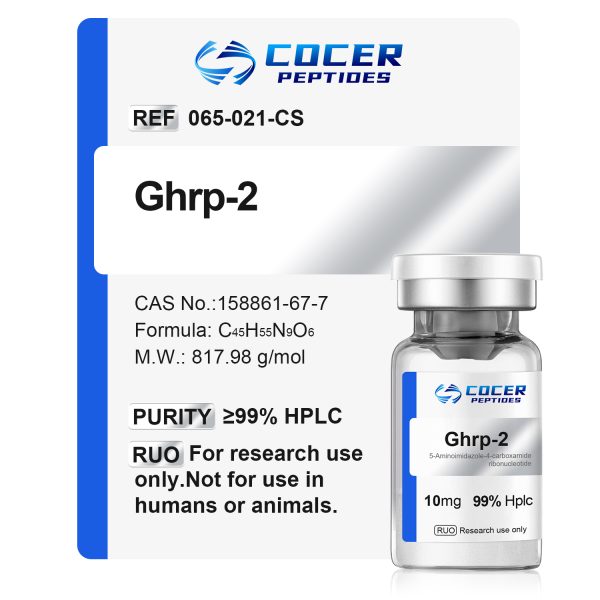
Ghrp-2 10mg
GHRP-2 is a synthetic amidated hexapeptide also known as pralmorelin (KP-102). Supplied as a lyophilized powder for laboratory research and analytical use only. Not intended for human or veterinary use, including consumption, injection, topical application, or any diagnostic, therapeutic, or clinical purpose.
Certificate of Analysis (COA)
Click “Check the COA” in the product section above to access the available Certificate of Analysis for this product. Please refer to the report for batch information and analytical results.
For laboratory research use only. Not for human or veterinary use.
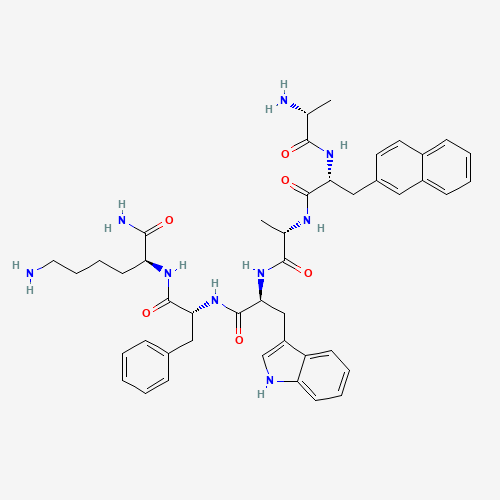
GHRP-2 Structure
 PubChem
- Sequence:AXAWFK
- Molecular Formula:C45H55N9O6
- Molecular Weight:817.98 g/mol
- CAS Number:158861-67-7
GHRP-2 Research
Molecular Background
Growth Hormone-Releasing Peptide-2 (GHRP-2), also known as pralmorelin or KP-102, is a synthetic amidated hexapeptide. PubChem lists GHRP-2 under CID 6918245, with the sequence H-D-Ala-D-2-Nal-Ala-Trp-D-Phe-Lys-NH₂, the molecular formula C45H55N9O6, and a molecular weight of approximately 818.0 g/mol. Published studies have characterized GHRP-2 as a ligand of the growth hormone-secretagogue receptor.[9]
Research Progress
Cheng et al. used rat primary pituitary cells to compare the growth-hormone-releasing responses to GHRP-2 and GHRP-6. The investigators measured GH release after exposing cultured cells to the peptides alone and in combination with growth hormone-releasing factor (GRF). Both peptides stimulated GH release in the rat pituitary-cell system and acted synergistically with GRF. Co-administration of GHRP-2 and GHRP-6 at maximal concentrations did not produce a larger response than either peptide alone, and the authors reported evidence that the two peptides acted through the same receptor mechanism under the conditions of the experiment.[2]
Miriam Granado and colleagues studied GHRP-2 in male Wistar rats with Freund’s-adjuvant-induced arthritis and in cultured peritoneal macrophages. Arthritic and control rats received GHRP-2 or saline under the study protocol, and the investigators measured food intake, arthritis score, paw volume, serum ghrelin and leptin, IL-6, and nitrite/nitrate concentrations. The authors reported lower arthritis scores, paw-volume measurements, and serum IL-6 in GHRP-2-treated arthritic rats compared with arthritic controls. In the cell experiments, GHRP-2 and ghrelin were associated with lower endotoxin-induced IL-6 and nitrite/nitrate release from peritoneal macrophages. These findings were generated in a rat inflammatory model and an ex vivo cell system.[3]
Fig1. Serum nitrite/nitrate and IL-6 measurements reported in control and adjuvant-arthritis rats exposed to saline or GHRP-2 in the cited study.[3]
The source figure presents serum nitrite/nitrate and IL-6 concentrations together with the statistical comparisons reported by the study authors. Group size, dose, route, and experimental procedures are described in the original publication.[3]
Matthias Tschöp and colleagues examined GHRP-2 in NPY-deficient mice and wild-type controls to investigate the mechanisms associated with positive energy balance in this model. Daily subcutaneous exposure was associated with dose-dependent changes in food intake and body weight, while body-composition analysis showed increases in fat and bone mass without a corresponding increase in lean mass. The authors also reported changes in respiratory quotient and hypothalamic agouti-related protein (AGRP) expression. Pharmacological blockade of melanocortin signaling altered the GHRP-2-associated weight response in NPY-deficient mice, supporting a role for AGRP-related signaling under the experimental conditions.[4]
Jane S. Titterington and colleagues evaluated GHRP-2 in ApoE-deficient mice over a 12-week experimental period and also performed cell-based studies using vascular smooth-muscle cells and macrophages. The authors reported higher circulating IGF-I and lower interferon-γ concentrations, together with lower aortic superoxide and 12/15-lipoxygenase-related measurements in GHRP-2-treated mice. Atherosclerotic plaque area, however, was not significantly reduced. In the cell experiments, the investigators reported changes in oxidative-stress, apoptosis, and lipid-accumulation-related endpoints. The study therefore showed differences in selected molecular and oxidative-stress markers without demonstrating a reduction in established plaque burden in this mouse model.[5]
Fig2. Atherosclerotic and vascular oxidative-stress measurements reported in ApoE-deficient mice exposed to GHRP-2.[5]
The source figure includes en face and cross-sectional plaque analysis, DHE-based superoxide measurements, and 12/15-lipoxygenase immunohistochemistry. Statistical comparisons and group sizes are reported in the original publication.[5]
L. T. Phung and colleagues conducted two experiments in crossbred castrated male swine to examine GH responses after GHRP-2 was given by oral gavage or mixed into feed. In the gavage experiment, the authors reported dose-related increases in peak GH concentrations and GH area-under-the-curve measurements, with values returning toward baseline over the sampling period. In the feed experiment, higher study doses were associated with measurable GH responses on the first and third treatment days, while the lowest dose did not produce the same response. These findings describe short-term endocrine measurements in swine under the specific exposure conditions used in the study.[6]
Katsuyoshi Kudoh and colleagues studied GHRP-2 in conscious dogs with intact vagal innervation and in dogs that had undergone vagotomy and pyloroplasty. Strain-gauge force transducers were used to monitor gastric, duodenal, and jejunal contractile activity, and the investigators also measured food intake. The authors reported dose-related changes in postprandial motility measurements and found that the feeding response observed in neurointact dogs was not reproduced after vagotomy. Antagonist experiments were used to examine the neural pathways involved in the gastrointestinal responses reported in the study.[7]
Fig3. Motility-index measurements reported after GHRP-2 exposure in vagotomized dogs in the cited study.[7]
The source figure compares gastric-antral, duodenal, and proximal-jejunal motility-index ratios across the study doses. Group size and statistical comparisons are reported in the original publication.[7]
Vonika Nou and colleagues examined GH responses to GHRP-2 and GHRH in swine after pretreatment with atropine or pyridostigmine. Atropine reduced the overall GH area under the curve, blocked the response to GHRH, and attenuated the response to combined GHRP-2 and GHRH, while the response to GHRP-2 alone was not significantly altered. Pyridostigmine increased plasma GH and augmented the responses to GHRP-2 and the GHRP-2/GHRH combination without increasing the GHRH response alone. The authors interpreted these findings as evidence that cholinergic signaling modifies GH responses to these secretagogues in swine.[8]
Research Limitations
The studies summarized above were conducted in rat pituitary cells, rodent disease models, swine, dogs, and vascular cell systems. Results from these models are not directly interchangeable, and differences in species, receptor biology, exposure route, experimental dose, study duration, and measured endpoints can materially affect the observations reported. The ApoE-deficient mouse study is also an example of this limitation: molecular and oxidative-stress-related endpoints changed while atherosclerotic plaque area did not significantly decrease.[5]
FDA has identified additional safety and characterization concerns for compounded GHRP-2 intended for injectable or nasal administration, including potential immunogenicity related to aggregation and peptide impurities and the presence of an unnatural amino acid. FDA also notes reports of serious adverse events in individuals who received GHRP-2, although causality was not established.[10] These regulatory observations do not describe the performance of a laboratory research material, but they further limit any extrapolation of the preclinical studies summarized above to human use.
COCER Peptides presents GHRP-2 solely for laboratory research and analytical use. It is not intended for human or veterinary use. The research described above summarizes findings reported in third-party publications and is not a statement of clinical efficacy, safety, diagnosis, treatment, prevention, or an instruction for use.
Relevant Citations
References
[1] Dickson S L. Ghrelin’s effects on growth hormone release: to pulse or not to pulse?[J]. Nature Reviews Endocrinology, 2022,18(8):457.
DOI:10.1038/s41574-022-00698-z.
[2] Cheng J, Wu T J, Butler B, et al. Growth hormone releasing peptides: a comparison of the growth hormone releasing activities of GHRP-2 and GHRP-6 in rat primary pituitary cells[J]. Life Sciences, 1997,60(16):1385-1392.
DOI:10.1016/s0024-3205(96)00655-8.
[3] Granado M, Priego T, Martín A I, et al. Anti-inflammatory effect of the ghrelin agonist growth hormone-releasing peptide-2 (GHRP-2) in arthritic rats[J]. American Journal of Physiology-Endocrinology and Diabetes, 2005,288(3):E486-E492.
DOI:10.1152/ajpendo.00196.2004.
[4] Tschöp M, Statnick M A, Suter T M, et al. GH-Releasing Peptide-2 Increases Fat Mass in Mice Lacking NPY: Indication for a Crucial Mediating Role of Hypothalamic Agouti-Related Protein[J]. Endocrinology, 2002,143(2):558-568.
DOI:10.1210/endo.143.2.8633.
[5] Titterington J S, Sukhanov S, Higashi Y, et al. Growth Hormone-Releasing Peptide-2 Suppresses Vascular Oxidative Stress in ApoE-/- Mice But Does Not Reduce Atherosclerosis[J]. Endocrinology, 2009,150(12):5478-5487.
DOI:10.1210/en.2009-0283.
[6] Phung L T, Sasaki A, Lee H G, et al. Effects of the administration of growth hormone-releasing peptide-2 (GHRP-2) orally by gavage and in feed on growth hormone release in swine[J]. Domestic Animal Endocrinology, 2001,20(1):9-19.
DOI:10.1016/s0739-7240(00)00085-0.
[7] Kudoh K, Shibata C, Funayama Y, et al. The effect of growth hormone releasing peptide-2 on upper gastrointestinal contractile activity and food intake in conscious dogs[J]. Journal of Gastroenterology, 2009,44(4):297-304.
DOI:10.1007/s00535-009-0025-y.
[8] Nou V, Tomoshi K, Inoue H, et al. Effect of atropine and pyridostigmine on growth hormone response to GH-releasing peptide-2 and GH-releasing hormone in swine[J]. Animal Science Journal, 2003,74(2):129-136.
DOI:10.1046/j.1344-3941.2003.00097.x.
[9] NCBI PubChem. Pralmorelin (GHRP-2). PubChem CID 6918245.
[10] U.S. Food and Drug Administration. Certain Bulk Drug Substances for Use in Compounding that May Present Significant Safety Risks: Growth hormone releasing peptide-2 (GHRP-2).
ALL PRODUCTS, ARTICLES, TECHNICAL MATERIALS, PRODUCT DESCRIPTIONS, AND OTHER INFORMATION PROVIDED ON THIS WEBSITE ARE INTENDED SOLELY FOR LEGITIMATE LABORATORY RESEARCH, INFORMATIONAL, AND EDUCATIONAL PURPOSES.
Products offered by Cocer Peptides are intended exclusively for in vitro and laboratory research and are NOT intended for human or veterinary use, human consumption, clinical use, diagnostic use, therapeutic use, compounding, self-administration, injection, or any other form of administration to humans or animals. These products are not intended to diagnose, treat, cure, mitigate, or prevent any disease or medical condition, nor are they intended to affect the structure or function of the human or animal body. Unless expressly stated otherwise, products offered on this website have not been evaluated or approved by the U.S. Food and Drug Administration (FDA) for human or veterinary use. Any references to published studies, biochemical pathways, molecular mechanisms, or experimental findings are provided solely for scientific discussion and research purposes and do not constitute medical advice, therapeutic claims, dosing guidance, or instructions for use. Purchasers are solely responsible for ensuring that all products are acquired, handled, stored, used, and disposed of in accordance with applicable laws, regulations, institutional requirements, and laboratory safety standards.