
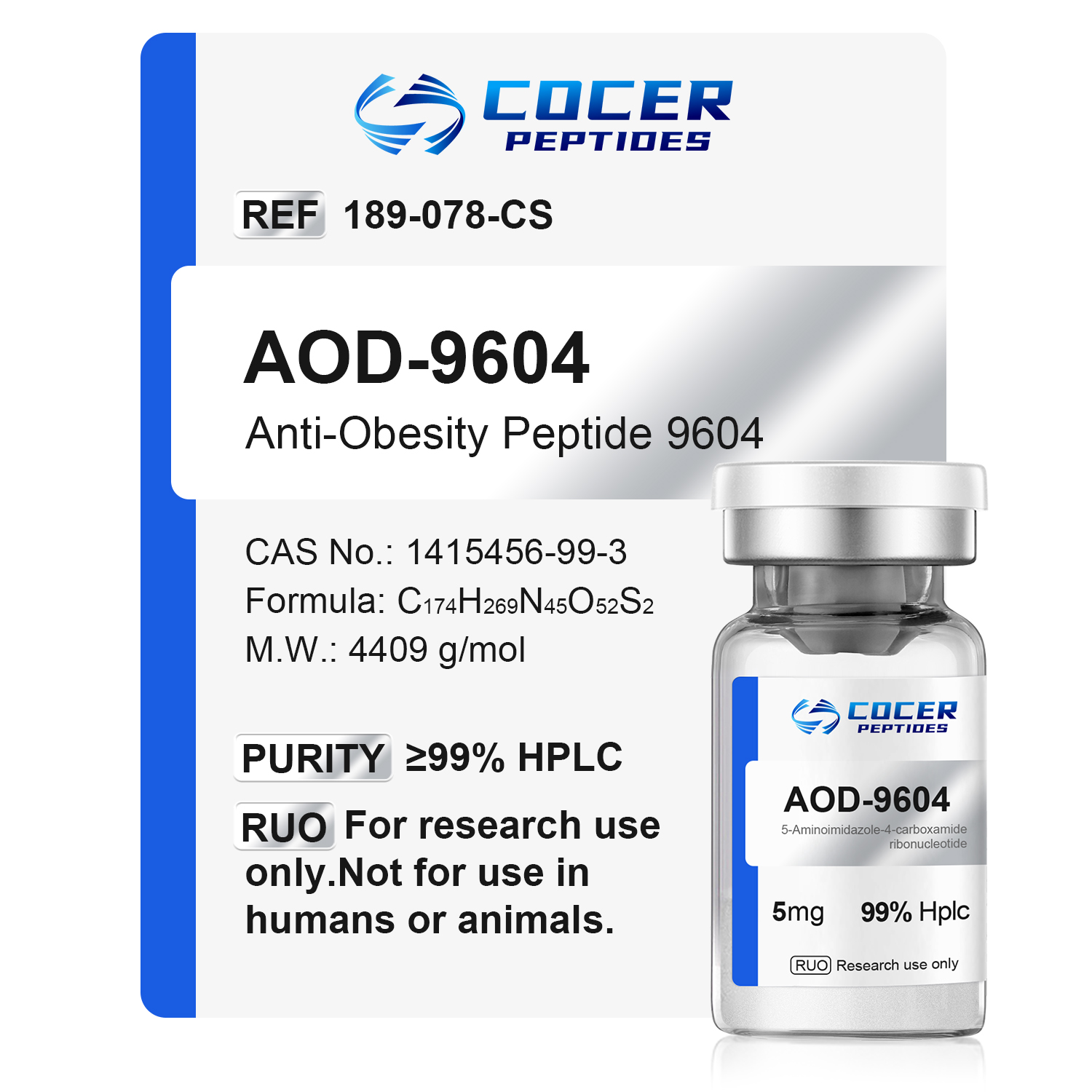
AOD 9604 5mg
AOD 9604 is a 15-amino-acid synthetic peptide derived from the C-terminal of human growth hormone , with tyrosine substituted for phenylalanine at the N-terminal.
The peptide will be provided as lyophilized powder to ensure maximum stability.
Certificate of Analysis (COA)
Click “Check the COA” in the product section above to access the available Certificate of Analysis for this product. Please refer to the report for batch information and analytical results.
For laboratory research use only. Not for human or veterinary use.
AOD 9604 Structure
- Sequence:SALLRSIPAPAGASRLLLLTGEIDLP
- Molecular Formula:C78H123N23O23S2
- Molecular Weight:1815.1g/mol
- CAS Number:221231-10-3
- PubChem CID:71300630
AOD-9604 Selank Research
AOD-9604 Selank Research
AOD-9604ResearchMolecular BackgroundAOD-9604 is a synthetic 16-amino-acid peptide corresponding to residues 177-191 of human growth hormone with an additional N-terminal tyrosine. PubChem lists AOD-9604 under CID 71300630, with the sequence YLRIVQCRSVEGSCGF, a disulfide bond between Cys7 and Cys14, the molecular formula C78H123N23O23S2, and a molecular weight of approximately 1815.1 g/mol.[7]Fig1. Product-ion mass spectra reproduced in the cited analytical review: (a) TB-500 and (b) AOD-9604.
Only panel (b) represents AOD-9604; panel (a) is shown as comparative analytical context from the source publication.[1]Research ProgressOmar F. Rahman and colleagues reviewed the emerging literature on peptide-based approaches in orthopaedic research and included AOD-9604 among compounds discussed in relation to cartilage and metabolic studies. The review cited preclinical AOD-9604 work, including the rabbit osteoarthritis model, and noted the limited state of clinical evidence for many peptides discussed.
Because this publication is a narrative review rather than a direct AOD-9604 experiment, its mechanistic statements should be interpreted as secondary synthesis of the literature rather than independent experimental evidence.[2]Holly D. Cox and colleagues developed and validated a solid-phase extraction method for detecting AOD-9604 in urine, with a reported limit of detection of 50 pg/mL, precision below 20%, specificity, and 62% recovery. The investigators also incubated AOD-9604 in serum and urine and identified six potential metabolites.
Quantification in serum identified the CRSVEGSCG fragment as more stable than the other detected metabolites or the parent peptide. The study was designed for analytical detection and in vitro metabolism and did not evaluate clinical efficacy or safety.[3]Andreas Thomas and colleagues developed a direct-urine-injection liquid chromatography-ion mobility time-of-flight mass spectrometry method for several low-molecular-mass peptides, including AOD-9604. Across the peptide panel, reported limits of detection ranged from 50 to 500 pg/mL, with imprecision below 20% and linearity over the evaluated working range.
The authors also examined peptide stability in urine and identified -20°C as an appropriate storage condition for the analytical workflow. The study addressed sports-drug-testing detection rather than biological effects of AOD-9604.[4]Dong Rak Kwon and Gi Young Park evaluated AOD-9604 with or without hyaluronic acid (HA) in a collagenase-induced knee osteoarthritis model using 32 mature New Zealand white rabbits. Animals received weekly intra-articular injections of saline, HA, AOD-9604, or AOD-9604 plus HA during the study period.
The authors assessed gross morphology, histopathology, and lameness and reported lower degeneration scores in the AOD-9604 and HA study groups than in saline controls, with the combination group showing lower scores than either AOD-9604 or HA alone. These findings were obtained in a collagenase-induced rabbit model and should not be interpreted as evidence of clinical efficacy in humans.[5]Fig2. Gross morphological and histological findings reported in the collagenase-induced rabbit knee osteoarthritis model.
Group 1 received saline, Group 2 hyaluronic acid, Group 3 AOD-9604, and Group 4 AOD-9604 plus hyaluronic acid. Complete dosing, scoring methods, and statistical comparisons are reported in the original publication.[5]M. Heffernan and colleagues examined human growth hormone and its synthetic C-terminal fragment AOD-9604 in lean, obese, and beta3-adrenergic-receptor knockout mice.
After 14 days of repeated intraperitoneal exposure, the authors reported differences in body-weight and body-fat measurements in obese mice together with changes in beta3-adrenergic-receptor RNA expression. In beta3-adrenergic-receptor knockout mice, the chronic body-weight and lipolysis-associated responses observed in wild-type animals were not reproduced, although acute AOD-9604 exposure still altered energy-expenditure and fat-oxidation measurements. The authors concluded that the observed effects were not mediated directly through the beta3-adrenergic receptor.
These results are specific to the mouse models and experimental conditions used.[6]Fig3. Body-weight and food-intake measurements reported after repeated saline, AOD-9604, or human growth hormone exposure in lean and obese mice. Group size, study dose, statistical methods, and complete experimental procedures are reported in the original publication.[6]Research LimitationsThe studies summarized above address different questions and use analytical methods, in vitro metabolism, rabbit osteoarthritis, and mouse metabolic models.
Results from these systems are not directly interchangeable. The rabbit study used intra-articular exposure in a collagenase-induced model, while the mouse study used repeated intraperitoneal exposure and genetic beta3-adrenergic-receptor knockout models.[5,6] These studies do not establish the safety, efficacy, pharmacokinetics, or clinical performance of an independently supplied AOD-9604 research material.FDA currently identifies AOD-9604 among bulk substances for which compounded drug products may present significant safety risks. FDA notes potential immunogenicity concerns for certain routes, complexities involving peptide-related impurities and active-pharmaceutical-ingredient characterization, and limited safety-related information.
FDA has also identified serious adverse events that may be associated with AOD-9604, although causality is not established.[8] These regulatory observations further limit extrapolation of the preclinical literature to human use.COCER Peptides presents AOD-9604 solely for laboratory research and analytical use. It is not intended for human or veterinary use. This COCER Peptides material is not an FDA-approved drug product.
The research described above summarizes findings reported in third-party publications and is not a statement of clinical efficacy, safety, diagnosis, treatment, prevention, or an instruction for use.
Relevant Citations
References
References
[1] Thevis M, Schänzer W. Analytical approaches for the detection of emerging therapeutics and non-approved drugs in human doping controls[J]. Journal of Pharmaceutical and Biomedical Analysis, 2014,101:66-83.DOI:https://doi.org/10.1016/j.jpba.2014.05.020.
[2] Rahman O F, Lee S J, Seeds W A. Therapeutic Peptides in Orthopaedics: Applications, Challenges, and Future Directions[J]. Journal of the American Academy of Orthopaedic Surgeons Global Research Reviews, 2026,10(1):e25.00236.DOI:10.5435/JAAOSGlobal-D-25-00236.
[3] Cox H D, Smeal S J, Hughes C M, et al. Detection and in vitro metabolism of AOD9604[J]. Drug Testing and Analysis, 2015,7(1):31-38.DOI:10.1002/dta.1715.
[4] Thomas A, Görgens C, Guddat S, et al. Simplifying and expanding the screening for peptides 2 kDa by direct urine injection, liquid chromatography, and ion mobility mass spectrometry[J]. Journal of Separation Science, 2016,39(2):333-341.DOI:10.1002/jssc.201501060.
[5] Kwon D R, Park G Y. Effect of Intra-articular Injection of AOD9604 with or without Hyaluronic Acid in Rabbit Osteoarthritis Model[J]. Annals of Clinical Laboratory Science, 2015,45(4):426-432.PMID:26275694
[6] Heffernan M, Summers R J, Thorburn A, et al. The effects of human GH and its lipolytic fragment (AOD9604) on lipid metabolism following chronic treatment in obese mice and beta(3)-AR knock-out mice[J]. Endocrinology, 2001,142(12):5182-5189.DOI:10.1210/endo.142.12.8522.
[7] NCBI PubChem. AOD-9604. PubChem CID 71300630.
[8] U.S. FDA. Certain Bulk Drug Substances that May Present Significant Safety Risks: AOD-9604.ALL PRODUCTS, ARTICLES, TECHNICAL MATERIALS, PRODUCT DESCRIPTIONS, AND OTHER INFORMATION PROVIDED ON THIS WEBSITE ARE INTENDED SOLELY FOR LEGITIMATE LABORATORY RESEARCH, INFORMATIONAL, AND EDUCATIONAL PURPOSES.Products offered by Cocer Peptides are intended exclusively for in vitro and laboratory research and are NOT intended for human or veterinary use, human consumption, clinical use, diagnostic use, therapeutic use, compounding, self-administration, injection, or any other form of administration to humans or animals. These products are not intended to diagnose, treat, cure, mitigate, or prevent any disease or medical condition, nor are they intended to affect the structure or function of the human or animal body. Unless expressly stated otherwise, products offered on this website have not been evaluated or approved by the U.S. Food and Drug Administration (FDA) for human or veterinary use. Any references to published studies, biochemical pathways, molecular mechanisms, or experimental findings are provided solely for scientific discussion and research purposes and do not constitute medical advice, therapeutic claims, dosing guidance, or instructions for use. Purchasers are solely responsible for ensuring that all products are acquired, handled, stored, used, and disposed of in accordance with applicable laws, regulations, institutional requirements, and laboratory safety standards.