
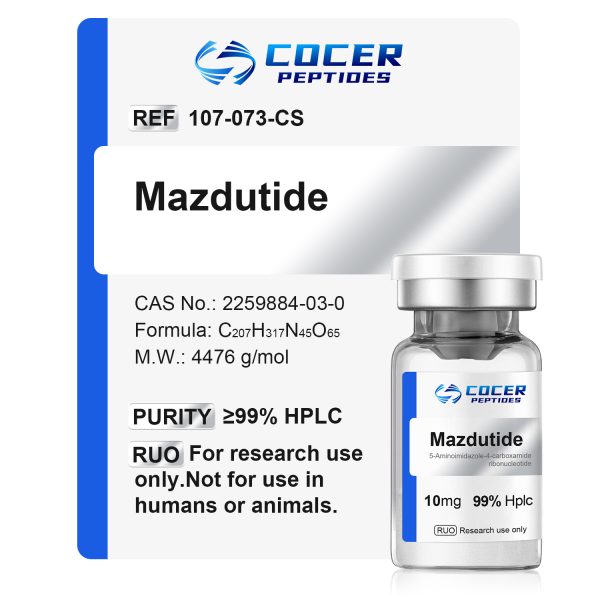
Mazdutide 10mg
Mazdutide (IBI362) is a synthetic, long-acting acylated peptide investigated as a dual GLP-1R/GCGR agonist. Supplied as a lyophilized powder for laboratory research and analytical use only. Not intended for human or veterinary use, including consumption, injection, topical application, or any diagnostic, therapeutic, or clinical purpose.
Certificate of Analysis (COA)
Click “Check the COA” in the product section above to access the available Certificate of Analysis for this product. Please refer to the report for batch information and analytical results.
For laboratory research use only. Not for human or veterinary use.
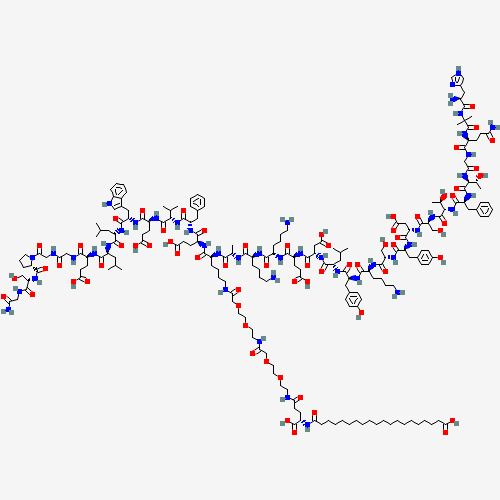
Mazdutide Structure
 PubChem
- Sequence:AEGTFTSDVSSYLEGQAAKFIAWLVKGRG
- Molecular Formula:C207H317N45O65
- Molecular Weight:4476g/mol
- CAS Number:2259884-03-0
- PubChem CID:167312357
Selank Research
Molecular Background
Mazdutide (IBI362; LY3305677) is a synthetic, long-acting acylated single-chain peptide analogue of oxyntomodulin that has been investigated as a dual agonist of the glucagon-like peptide-1 receptor (GLP-1R) and glucagon receptor (GCGR). PubChem lists Mazdutide under CID 167312357, with the molecular formula C207H317N45O65 and a molecular weight of approximately 4476 g/mol.[7]
Research Progress
Qi Wu and colleagues compared Mazdutide with semaglutide in diet-induced obese mice over an 8-week experimental period while maintaining comparable glycemic control. Mazdutide was administered at 30 nmol/kg once weekly and semaglutide at 30 nmol/kg every other day. The investigators measured body weight, serum and hepatic lipid-related parameters, liver histology, and hepatic transcriptomic responses. They reported a greater reduction in body weight in the Mazdutide group, together with lower serum triglyceride, total-cholesterol, and LDL-cholesterol measurements and differences in liver lipid-related endpoints. RNA-sequencing and pathway analysis identified changes in oxidative-phosphorylation and fatty-acid-degradation pathways, including higher expression of Ehhadh, Cyp4a14, Hadha, Fgf21, and Gdf15. The authors proposed ATF3 as a candidate transcriptional regulator associated with these findings. This work was published as a conference abstract and therefore provides more limited methodological detail than a full-length peer-reviewed report.[1]
Hui Wang and Ling Li studied Mazdutide in C57BL/6J mice maintained for 32 weeks on an AMLN diet to establish a model with steatohepatitis and fibrosis-related features. Mice then received vehicle, a GLP-1R agonist, a GCGR agonist, or Mazdutide every 2 days for 6 weeks. The authors assessed body and liver weight, insulin and glucose tolerance, inflammatory markers, hepatic histology, fibrosis-related measurements, intestinal structure, and fecal microbiome composition. They reported differences in hepatic triglycerides, inflammatory cytokines, steatosis, fibrosis-related measurements, and the abundance of selected gut-microbiota taxa in the Mazdutide group compared with model controls and single-receptor agonist groups. These results were presented as a conference abstract and remain specific to the mouse model and study conditions described.[2]
Yanshuang Ren and colleagues investigated Mazdutide in a hyperuricemia rat model established using a high-fat diet followed by adenine and potassium oxonate exposure. After the intervention period, the investigators used single-nucleus RNA sequencing and metabolomic analysis to examine hepatic gene expression and metabolic changes. They reported increased expression of several fatty-acid-oxidation-related genes and lower expression of selected fatty-acid-synthesis and glucose/purine-metabolism genes in Mazdutide-treated rats. Metabolomic measurements also showed differences in glucose, glucose-6-phosphate, glutamine, xanthine- and adenosine-related metabolites, and uric acid compared with model animals. This work was published as a conference abstract and should be interpreted as preclinical evidence from the specific rat model studied.[3]
Wanqing Dong and colleagues compared Mazdutide with dulaglutide in male db/db mice, a model used to study diabetes-associated cognitive dysfunction. Behavioral testing was combined with brain histopathology, transcriptomics, proteomics, and metabolomics. The authors reported differences in cognitive-test performance, neuronal and myelin-related measurements, synaptic-plasticity-associated markers, and multiple metabolic and molecular pathways in Mazdutide-treated mice. The authors also emphasized that the animal findings were obtained in male mice. These results describe a preclinical disease model and do not establish cognitive effects in humans.[4]
Fig1. Body-weight, food-intake, and water-intake measurements reported in male db/db mice during the Mazdutide and dulaglutide study.[4]
The source figure shows the experimental schedule and longitudinal body-weight and intake measurements across saline, Mazdutide dose groups, and dulaglutide. Group sizes, doses, statistical methods, and complete experimental procedures are reported in the original publication.[4]
Liangyu Gan and colleagues evaluated Mazdutide in a high-fat-diet mouse model of early-stage metabolic dysfunction-associated steatotic liver disease (MASLD) and in free-fatty-acid-treated hepatocytes. Mice received Mazdutide for 4 weeks after 12 weeks of high-fat feeding, while cultured hepatocytes were exposed to Mazdutide or the ER-stress inhibitor 4-phenylbutyric acid under the study design. The investigators measured serum and hepatic lipid profiles, liver-injury markers, inflammatory cytokines, histopathology, oxidative-stress markers, and proteins related to ER stress and lipid metabolism. They reported differences in hepatic steatosis, lipid accumulation, inflammatory and oxidative-stress measurements, PERK-pathway markers, NF-kB-related signaling, and expression of SREBP-1, C/EBPbeta, and PPARgamma. These findings were obtained in mouse and cell models and should remain limited to those experimental systems.[5]
Fig2. Liver histology and hepatic lipid measurements reported in the high-fat-diet MASLD mouse model after Mazdutide exposure.[5]
The source figure includes H&E and Oil Red O staining together with hepatic triglyceride, total-cholesterol, and free-fatty-acid measurements. Group definitions, sample sizes, and statistical comparisons are reported in the original publication.[5]
Huimin Xia and colleagues used a high-fat-diet mouse model to compare a GLP-1R/GCGR dual agonist (Mazdutide) with the GLP-1R monoagonist semaglutide using 9.4-T multiparametric MRI and tissue analysis. After 4 weeks, the investigators reported a greater reduction in MRI-derived proton-density fat fraction (PDFF) from baseline in the Mazdutide group than in the semaglutide group. Reductions in R2* values, used as an imaging measure related to liver iron content, were not significantly different between the two treatment groups at the reported time points. Liver PDFF correlated with hepatic triglycerides and histological steatosis scores. The study therefore supports differences in hepatic-fat imaging endpoints in this mouse model but does not establish equivalent findings in humans.[6]
Fig3. Experimental design, body-composition, tissue-weight, and MRI measurements reported in the high-fat-diet mouse study comparing Mazdutide with semaglutide.[6]
The source figure shows the dosing schedule, serial body-weight measurements, whole-body 9.4-T MRI, fat-to-mass and lean-to-mass ratios, and adipose-tissue and liver weights. Complete statistical methods and experimental conditions are reported in the original publication.[6]
Research Limitations
The studies summarized above use different preclinical systems, including diet-induced obese mice, AMLN-fed mice, hyperuricemic rats, db/db mice, high-fat-diet MASLD models, cultured hepatocytes, and multiparametric MRI. Results from these systems are not directly interchangeable. Three of the cited studies are conference abstracts rather than full-length research articles, which limits the amount of methodological, replication, and safety information available for independent evaluation.[1-3] The db/db cognitive study was performed in male mice only, and the hepatic studies used short experimental exposure periods relative to the duration required to evaluate chronic toxicologic outcomes.[4-6]
FDA has repeatedly cited U.S. research-peptide websites selling Mazdutide when website language linked the product to weight loss, glycemic control, liver-fat reduction, obesity, diabetes, or other human structure/function outcomes. In August 2026, FDA specifically identified a Mazdutide product page as evidence of intended drug use and stated that no approved application was in effect for that product.[8] For this reason, the animal and cell findings summarized above should remain clearly attributed to the cited investigators and should not be presented as claims regarding a COCER Peptides material.
COCER Peptides presents Mazdutide solely for laboratory research and analytical use. It is not intended for human or veterinary use. This COCER Peptides material is not an FDA-approved drug product. The research described above summarizes findings reported in third-party publications and is not a statement of clinical efficacy, safety, diagnosis, treatment, prevention, weight management, metabolic benefit, or an instruction for use.
Relevant Citations
References
[1] Wu Q, Wei T, Cui X, et al. 777-P: The Dual Glucagon and Glucagon-Like Peptide 1 Receptor Agonist Mazdutide Outbalanced Glucagon-Like Peptide 1 Receptor Agonist Semaglutide Monotherapy in Improving Mice Liver Fat Accumulation[J]. Diabetes, 2025,74(Suppl_1):777-P.
DOI:10.2337/db25-777-p.
[2] Wang H, Li L. 1616-P: Effect of Mazdutide on MASH Fibrosis-Targeting the Liver-Gut Axis and Microbiome[J]. Diabetes, 2025,74(Suppl_1):1616-P.
DOI:10.2337/db25-1616-p.
[3] Ren Y, Zhang Y, Liu C, et al. 775-P: Mazdutide, a Dual GLP-1R/GCGR Agonist, Reduces Hyperuricemia by Modulating Energy and Lipid Diabetes and Inhibiting Hepatic Purine Diabetes[J]. Diabetes, 2025,74(Suppl_1):775-P.
DOI:10.2337/db25-775-p.
[4] Dong W, Bai J, Yuan Q, et al. Mazdutide, a dual agonist targeting GLP-1R and GCGR, mitigates diabetes-associated cognitive dysfunction: mechanistic insights from multi-omics analysis[J]. eBioMedicine, 2025,117:105791.
DOI:10.1016/j.ebiom.2025.105791.
[5] Gan L, Duan L, Zheng X. Mazdutide Ameliorates Metabolic Dysfunction-Associated Steatotic Liver Disease by Modulating Endoplasmic Reticulum Stress, Improving Lipid Diabetes and Alleviating Inflammation[J]. Pharmaceuticals (Basel), 2026,19(3):371.
DOI:10.3390/ph19030371.
[6] Xia H, Min Y, Wang Y, et al. Multiparametric MRI Evaluation of Liver Fat and Iron after Glucagon-like Peptide-1 Receptor and Glucagon Receptor Dual-Agonist Treatment in a High-Fat Diet-induced Mouse Model[J]. Radiology, 2025,316(2):e243780.
DOI:10.1148/radiol.243780.
[7] NCBI PubChem. Mazdutide. PubChem CID 167312357.
[8] U.S. Food and Drug Administration. NuScience Peptides LLC, Warning Letter 733652, August 24, 2026.
ALL PRODUCTS, ARTICLES, TECHNICAL MATERIALS, PRODUCT DESCRIPTIONS, AND OTHER INFORMATION PROVIDED ON THIS WEBSITE ARE INTENDED SOLELY FOR LEGITIMATE LABORATORY RESEARCH, INFORMATIONAL, AND EDUCATIONAL PURPOSES.
Products offered by Cocer Peptides are intended exclusively for in vitro and laboratory research and are NOT intended for human or veterinary use, human consumption, clinical use, diagnostic use, therapeutic use, compounding, self-administration, injection, or any other form of administration to humans or animals. These products are not intended to diagnose, treat, cure, mitigate, or prevent any disease or medical condition, nor are they intended to affect the structure or function of the human or animal body. Unless expressly stated otherwise, products offered on this website have not been evaluated or approved by the U.S. Food and Drug Administration (FDA) for human or veterinary use. Any references to published studies, biochemical pathways, molecular mechanisms, or experimental findings are provided solely for scientific discussion and research purposes and do not constitute medical advice, therapeutic claims, dosing guidance, or instructions for use. Purchasers are solely responsible for ensuring that all products are acquired, handled, stored, used, and disposed of in accordance with applicable laws, regulations, institutional requirements, and laboratory safety standards.