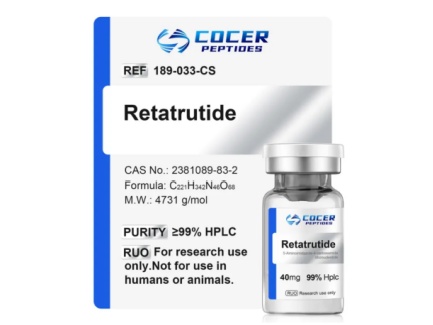
Any article titled Retatrutid Dosage Guide & Titration Schedule 2026 needs to begin with one important clarification: in 2026, retatrutide is still an investigational once-weekly injectable peptide, not an approved medicine with a public prescribing label. Lilly describes it as a triple hormone receptor agonist targeting GIP, GLP-1, and glucagon receptors, and states that it is legally available only to participants in its clinical trials. Lilly Medical also says retatrutide is not currently approved in any countries or geographies. That means the most accurate “dosage guide” today is not a consumer-use dosing instruction sheet, but a careful summary of the titration schedules, target doses, and tolerability patterns used in clinical studies. For readers following peptide development, procurement trends, or technical product information, that distinction matters because the conversation in 2026 is about trial-based dose escalation, not self-directed use.
What Retatrutid Means in 2026
Retatrutid has moved beyond early-stage excitement and into a broad Phase 3 development program. Lilly reported in March 2026 that its first Phase 3 type 2 diabetes study, TRANSCEND-T2D-1, met its primary and key secondary endpoints, while earlier Phase 3 obesity-related readouts such as TRIUMPH-4 had already shown strong weight-loss results. Even so, Lilly continues to describe retatrutide as investigational, and ongoing studies are still evaluating how different doses perform across obesity, type 2 diabetes, knee osteoarthritis, obstructive sleep apnea, cardiovascular outcomes, renal outcomes, and liver-related disease settings.
This matters for dosage discussions because there is no single approved maintenance dose yet. Instead, the 2026 picture is built around the doses that Lilly is actively taking through Phase 3: 4 mg, 9 mg, and 12 mg, all delivered once weekly after a gradual step-up approach.
Why a Retatrutid Dosage Guide Needs a Caution Label
In peptide discussions online, dosage content often gets simplified into charts that look more settled than the science actually is. With retatrutide, that is misleading. Lilly explicitly warns that the molecule has not been reviewed or approved by any regulatory agency and says no one should consider taking anything claiming to be retatrutide outside a Lilly-sponsored clinical trial. The FDA has also warned consumers about unapproved products containing retatrutide sold with dosing instructions, noting that such products may be of unknown quality and potentially harmful.
So, for SEO readers and industry buyers alike, the responsible framing is this: retatrutide dosage in 2026 refers to investigational clinical trial dosing, not retail or routine prescription dosing. That also explains why most reliable information comes from Lilly releases, Lilly Medical materials, ClinicalTrials.gov listings, and peer-reviewed trial publications rather than seller-generated charts.
The Core Titration Pattern Used in Phase 3
The clearest dosing pattern in 2026 comes from Lilly’s Phase 3 materials. In TRANSCEND-T2D-1, participants randomized to retatrutide started at 2 mg once weekly and increased in a step-wise approach every four weeks until they reached their assigned target dose. Lilly described the same basic escalation principle across the TRIUMPH obesity program as well.
That produces a practical trial-based titration structure:
Target Dose | Weeks 1–4 | Weeks 5–8 | Weeks 9–12 | Weeks 13–16 | Week 17 onward |
4 mg | 2 mg | 4 mg | maintain | — | — |
9 mg | 2 mg | 4 mg | 6 mg | 9 mg | maintain |
12 mg | 2 mg | 4 mg | 6 mg | 9 mg | 12 mg |
This table summarizes the step-up schedules Lilly reported for Phase 3 target doses. In other words, the 4 mg arm uses one escalation step after the starting phase, the 9 mg arm uses three dose levels before maintenance, and the 12 mg arm uses four. The design is clearly built to improve tolerability rather than rush participants to the highest exposure.
How Phase 2 Helped Shape the 2026 Dosing Conversation
Retatrutid’s Phase 2 obesity study remains important because it showed why dose selection became such a central issue. Lilly reported that in adults with obesity or overweight without diabetes, retatrutide achieved up to 17.5% mean weight reduction at 24 weeks and up to 24.2% at 48 weeks. The New England Journal of Medicine publication also shows that the study explored multiple retatrutide dose arms rather than a single fixed pathway, including lower and higher-dose groups.
What Phase 2 really changed was the market’s understanding of dose-response. The higher-dose arms generated the strongest weight-loss signals, but gastrointestinal side effects were also concentrated around dose escalation. That is one reason later development moved toward a more structured titration philosophy instead of treating retatrutide as a simple fixed-dose product.

Why Titration Matters More Than the Final Number
A common mistake in peptide content marketing is to focus only on the final dose. With retatrutide, the path to the dose is almost as important as the number itself. In Lilly’s 2026 Phase 3 diabetes release, the most common adverse events were nausea, diarrhea, and vomiting, and Lilly noted that they occurred primarily during dose escalation. That detail is critical because it explains the logic behind the 2 mg starting dose and the four-week step-up intervals.
The same pattern appears in TRIUMPH-4. Lilly reported gastrointestinal adverse events such as nausea, diarrhea, constipation, vomiting, and decreased appetite, as well as dysesthesia in some participants. Discontinuation due to adverse events was higher in the 9 mg and 12 mg groups than placebo, and Lilly said those discontinuations were strongly correlated with baseline BMI, with some discontinuations related to perceived excessive weight loss.
What the 4 mg, 9 mg, and 12 mg Targets Suggest
The three target doses that stand out in 2026 are 4 mg, 9 mg, and 12 mg. They do not all appear in every study population in the same way. In TRANSCEND-T2D-1, Lilly reported A1C reductions at 40 weeks of -1.7% for 4 mg, -2.0% for 9 mg, and -1.9% for 12 mg, while body-weight reductions were -11.5%, -15.5%, and -16.8% respectively.
In obesity-focused Phase 3 work, Lilly has emphasized the upper doses more heavily. In TRIUMPH-4, the 9 mg and 12 mg groups produced mean body-weight reductions of -26.4% and -28.7% at 68 weeks in adults with obesity or overweight and knee osteoarthritis. Lilly also noted that additional TRIUMPH results expected in 2026 include a maintenance dose of 4 mg alongside the 9 mg and 12 mg doses already highlighted in that study.
Taken together, these data suggest a 2026 development logic in which 4 mg may serve as a lower-intensity maintenance option, while 9 mg and 12 mg are the more aggressive investigational targets being studied where larger weight-loss effects are central. That is an interpretation based on trial design and topline data, not an approved prescribing rule.
A Practical 2026 Reading of the Titration Schedule
For readers trying to understand the retatrutide titration schedule in plain terms, the trial model is fairly consistent:
Starting phase
Most late-stage studies begin with 2 mg once weekly.
Escalation phase
The dose increases every four weeks, usually moving through intermediate steps such as 4 mg, 6 mg, and 9 mg on the way to a higher target.
Maintenance phase
Once the assigned target is reached, participants generally remain there for the rest of the treatment period unless the protocol allows interruptions or dose modifications. Lilly’s materials describe this as a step-wise escalation to the target dose followed by continued treatment at that level.
Final Thoughts
Retatrutid is one of the most closely watched metabolic peptides in 2026, but its dosage story is still a development-stage story, not a finished commercial one. The strongest evidence available today points to a weekly injectable regimen that starts at 2 mg, escalates every four weeks, and aims for target doses such as 4 mg, 9 mg, or 12 mg depending on the protocol. Phase 2 and Phase 3 findings help explain why that structure exists: higher doses appear to drive stronger efficacy signals, while the escalation period is where tolerability becomes most important. From our perspective, that makes careful interpretation more valuable than hype. For readers, sourcing teams, and industry buyers who want to understand retatrutide materials, peptide specifications, and the broader technical landscape in a more grounded way, it is worth learning more from Cocer Peptides Co., Ltd. and discussing the topic from an evidence-based, product-information standpoint rather than a shortcut dosing mindset.
FAQ
1. Is there an approved retatrutide dosage in 2026?
No. Lilly says retatrutide is investigational, legally available only through its clinical trials, and not approved by regulatory agencies.
2. What starting dose is most commonly used in late-stage studies?
The clearest Phase 3 pattern reported by Lilly starts participants at 2 mg once weekly, followed by step-wise increases every four weeks until the assigned target dose is reached.
3. Why is the titration schedule so gradual?
Lilly’s reported adverse events, especially nausea, diarrhea, and vomiting, occurred mainly during dose escalation, which is why a slower step-up schedule appears central to tolerability.
4. Are researchers still studying new retatrutide escalation plans?
Yes. ClinicalTrials.gov includes a study specifically evaluating different retatrutide dose escalation schemes, showing that titration strategy is still being refined.