1kits(10Vials)
| Availability: | |
|---|---|
| Quantity: | |
▎Certificate of Analysis (COA)
Click “Check the COA” in the product section above to access the available Certificate of Analysis for this product. Please refer to the report for batch information and analytical results.
For laboratory research use only. Not for human or veterinary use.
▎CJC1295 No DAC Structure
Source: PubChem | Sequence: YADAXFXQSYRKVLAQLSARKLLQDXLSR Molecular Formula: C152H252N44O42 Molecular Weight: 3367.9g/mol CAS Number: 446262-90-4 PubChem CID: 91976842 |
▎CJC1295 No DAC Research
Molecular Background
CJC-1295 is a synthetic GHRH analog whose structural modifications are designed to increase resistance to degradation by dipeptidyl peptidase-4 (DPP-4). CJC-1295 without DAC (sometimes described in the literature as Mod GRF 1-29) lacks the drug-affinity complex that enables covalent binding to plasma albumin; the terminology does not necessarily establish the identity of all preparations[1].
Research Progress
A review by Aleksander Dominikowski discussed the proposed mechanism of action of CJC-1295 No DAC. Based on the activity of related GHRH analogs, resistance to degradation by dipeptidyl peptidase-4 (DPP-4) and interaction with the GHRH receptor on anterior pituitary somatotroph cells have been proposed, potentially involving the adenylate cyclase-cAMP-PKA signaling pathway. However, direct compound-specific evidence for CJC-1295 No DAC remains limited[1].
Research by Mark Timms on plasma testing in horses examined the detection of CJC-1295 protein conjugates using an ELISA assay. Because the study focused on DAC-associated plasma protein binding, it does not directly establish the clearance rate or duration of action of CJC-1295 No DAC. The absence of DAC may affect protein binding, but the pharmacokinetic profile of the DAC-free variant requires separate investigation[2].
Based on research involving related GHRH analogs, CJC-1295 No DAC may interact with the GHRH receptor on the surface of anterior pituitary somatotroph cells, potentially involving the adenylate cyclase-cAMP-PKA signaling pathway. Unlike ghrelin-related growth hormone secretagogues, GHRH receptor agonists are generally discussed in the context of regulatory feedback involving somatostatin. These mechanistic considerations do not establish a specific pharmacodynamic response to CJC-1295 No DAC[1].
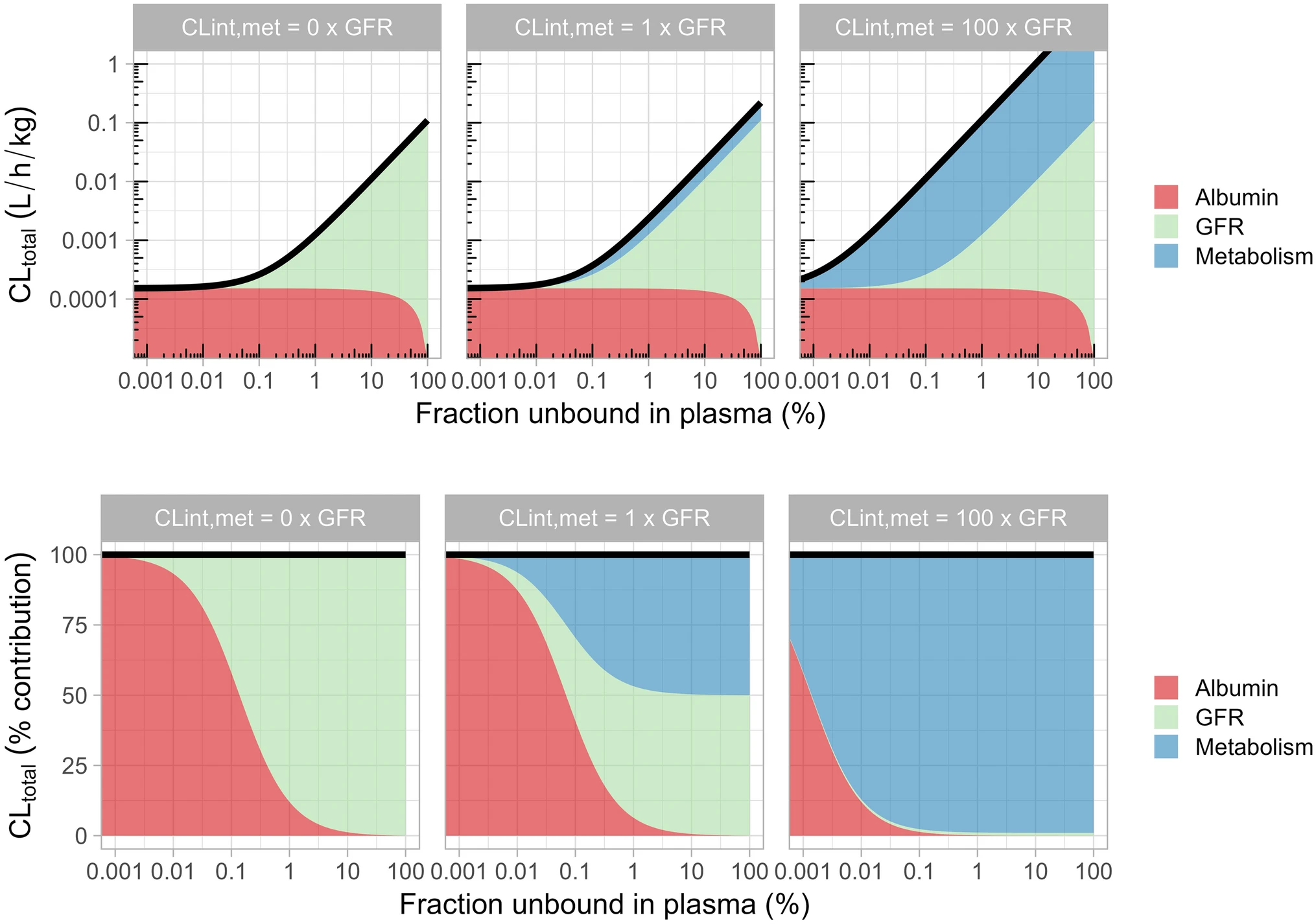
Pharmacokinetic (PK) studies have shown that the systemic clearance of peptide therapeutics is influenced by proteolytic degradation, glomerular filtration, and albumin-mediated processes. For CJC-1295 No DAC, the absence of DAC-mediated plasma protein binding may affect its PK profile, but direct data are insufficient to establish its absorption, clearance, or a specific pharmacodynamic (PD) pattern. In contrast, CJC-1295 containing DAC can form plasma protein conjugates, which have been studied in equine plasma. The general peptide clearance model in Fig1 illustrates the influence of plasma protein binding; it should not be interpreted as compound-specific PK data for CJC-1295 No DAC[1-3].

Fig1. Absolute (top) and relative (bottom) contribution of metabolism, glomerular filtration rate (GFR), and albumin-mediated elimination to total peptide clearance (black line) as a function of plasma protein binding, as described in reference [3].
Research Limitations
The safety profile of CJC-1295 No DAC has not been adequately established in direct compound-specific research. Theoretical concerns include altered endocrine signaling, while risks reported for other CJC-1295-related substances may not apply identically to the DAC-free form. FDA has identified potential immunogenicity, peptide-related impurities, and serious adverse events associated with CJC-1295-related substances; these observations should not be presented as specific findings for CJC-1295 No DAC. Unverified peptide identity, purity, and sterility also limit the interpretation of experimental outcomes[1, 4].
COCER Peptides presents CJC-1295 No DAC solely for non-clinical laboratory research. For research use only; not for human or veterinary use, administration, ingestion, diagnostic testing, or therapeutic application. The research discussed above summarizes findings reported in the cited literature and does not establish safety, clinical efficacy, or suitability for administration. CJC-1295 No DAC is not an FDA-approved drug.
▎Relevant Citations
References
[1] Dominikowski A, Rękoś Z, Olejarz M, et al. The emerging landscape of performance-enhancing peptides modulating GH-IGF1 axis: bridging the gap between clinical evidence and patient self-administration[J]. Frontiers in Endocrinology, 2026,17.
DOI:10.3389/fendo.2026.1822475.
[2] Timms M, Cawley A, Steel R. Detection of CJC‐1295 in Equine Plasma by ELISA[J]. Drug Testing and Analysis, 2026.
DOI:10.1002/dta.70171.
[3] Nordell P, Jansson-Löfmark R, Gennemark P. Systemic Pharmacokinetic Principles of Therapeutic Peptides[J]. Clinical Pharmacokinetics, 2026,65(4):571-582.
DOI:10.1007/s40262-025-01615-z.
[4] U.S. Food and Drug Administration (FDA). Certain Bulk Drug Substances for Use in Compounding that May Present Significant Safety Risks. FDA website. https://www.fda.gov/drugs/human-drug-compounding/certain-bulk-drug-substances-use-compounding-may-present-significant-safety-risks (accessed November 2, 2026).
ALL PRODUCTS, ARTICLES, TECHNICAL MATERIALS, PRODUCT DESCRIPTIONS, AND OTHER INFORMATION PROVIDED ON THIS WEBSITE ARE INTENDED SOLELY FOR LEGITIMATE LABORATORY RESEARCH, INFORMATIONAL, AND EDUCATIONAL PURPOSES.
Products offered by Cocer Peptides are intended exclusively for in vitro and laboratory research and are NOT intended for human or veterinary use, human consumption, clinical use, diagnostic use, therapeutic use, compounding, self-administration, injection, or any other form of administration to humans or animals. These products are not intended to diagnose, treat, cure, mitigate, or prevent any disease or medical condition, nor are they intended to affect the structure or function of the human or animal body. Unless expressly stated otherwise, products offered on this website have not been evaluated or approved by the U.S. Food and Drug Administration (FDA) for human or veterinary use. Any references to published studies, biochemical pathways, molecular mechanisms, or experimental findings are provided solely for scientific discussion and research purposes and do not constitute medical advice, therapeutic claims, dosing guidance, or instructions for use. Purchasers are solely responsible for ensuring that all products are acquired, handled, stored, used, and disposed of in accordance with applicable laws, regulations, institutional requirements, and laboratory safety standards.