The anti-aging and performance-optimization markets are expanding at an unprecedented rate. Consumers face a deeply saturated landscape of injectables, supplements, and wellness therapies. This explosive market growth frequently leads to a dangerous conflation of distinct compounds. People commonly confuse anabolic steroids and peptides, creating severe legal, safety, and health compliance risks. You must clearly understand these two substances represent entirely distinct biochemical entities. Amino acid chains act as delicate signaling molecules in your body. Synthetic lipid-based hormones force aggressive physiological overrides. The purpose of this guide is to equip you. We provide a skeptical, evidence-backed evaluation framework. You will discover the actual mechanisms, distinct risk profiles, and legal realities governing these interventions. By parsing out the science, you can make safe, informed, and compliant decisions regarding your health and longevity.
Key Takeaways
Biochemical Difference: Peptides are amino acid chains that prompt the body to produce its own hormones; steroids are synthetic hormones that directly override the body’s endocrine system.
Risk Profile: Peptides generally carry a lower risk of endocrine shutdown compared to steroids, but they are not risk-free and require strict clinical dosing.
Performance Reality: Peptides will not yield the rapid, aggressive muscle mass associated with anabolic steroids—claims suggesting otherwise are scientifically inaccurate.
Compliance: Numerous peptides are explicitly banned by WADA and USADA; "legal to buy" as a research chemical does not mean legal for athletic competition or safe for human consumption.
What Are Peptides and Steroids?
What is a Peptide?
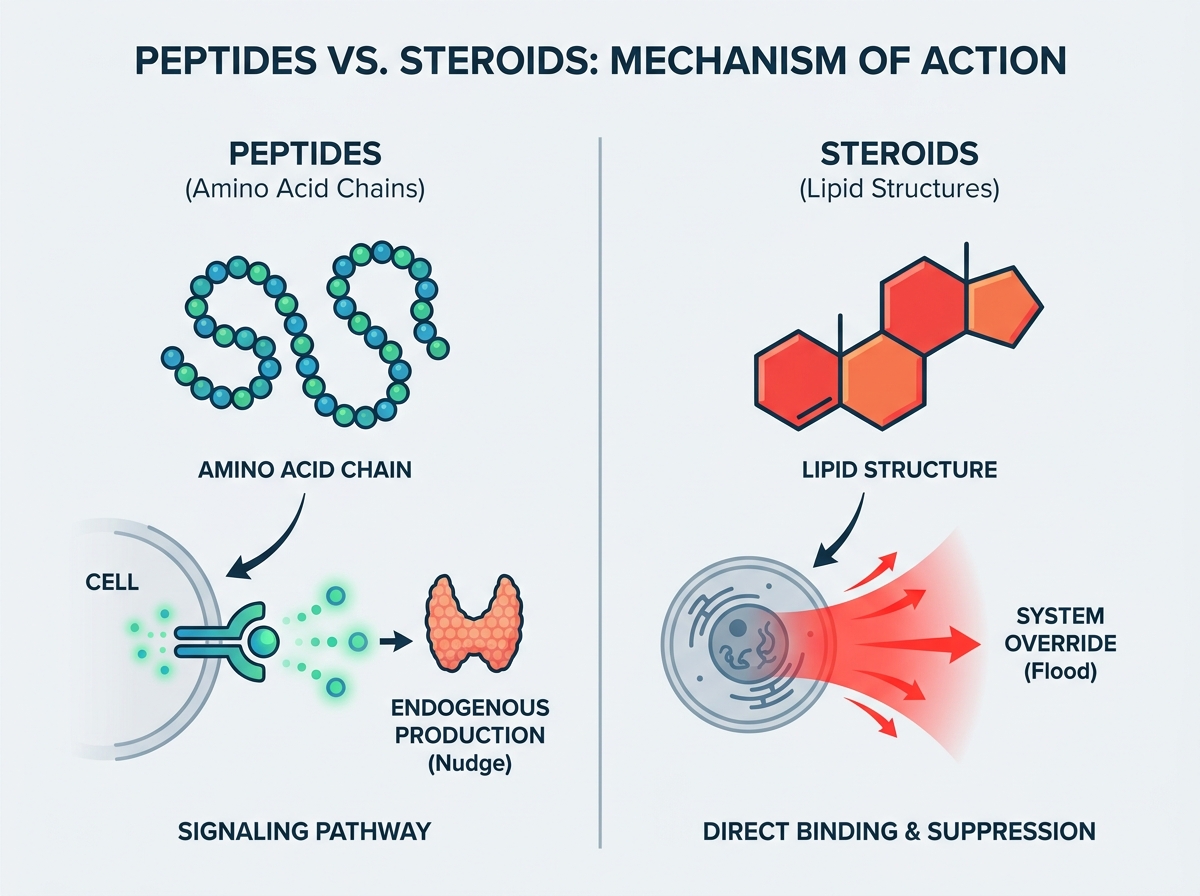
Biologically speaking, we define a peptide as a short chain of amino acids. These amino acids act as the fundamental building blocks of proteins. Chains typically range from 2 to 50 amino acids in length. They function primarily as biological messengers within the human body. They bind to specific cell surface receptors to trigger a precise physiological response. For example, some signaling molecules stimulate the pituitary gland to release your natural growth hormone.
Medical science relies heavily on these compounds for life-saving interventions. Insulin remains the most famous peptide hormone globally. Millions of diabetics use it daily to regulate blood sugar. Additionally, modern GLP-1 agonists operate as targeted peptides. They manage metabolic conditions and drive significant weight loss.
What is an Anabolic Steroid?
Steroids exist in a completely different structural category. We define them as lipid-based molecules constructed upon a core four-ring carbon framework. When people discuss muscle building, they specifically refer to Anabolic-Androgenic Steroids (AAS). These compounds are synthetic variations of testosterone.
Unlike amino acid chains, anabolic steroids penetrate the cell membrane directly. They travel into the cytoplasm. They bind directly to intracellular androgen receptors. This aggressive binding mechanism enters the cell nucleus to alter gene expression. They force rapid, unnatural protein synthesis across muscle tissues.
The Structural Contrast
You cannot fully grasp the clinical differences without comparing their core physical properties. Amino acids are highly water-soluble. The body degrades them rapidly, resulting in short half-lives. Lipids are fat-soluble. They boast much longer half-lives and accumulate in tissues over time. We can visualize these structural and functional contrasts in the comparison chart below.
Characteristic
Peptide Molecules
Anabolic Steroids
Base Structure
Short chains of amino acids (2-50)
Four-ring carbon (lipid-based)
Solubility
Water-soluble (rapid degradation)
Fat-soluble (tissue accumulation)
Receptor Binding
Cell surface receptors
Intracellular receptors (nucleus)
Origin Example
Insulin, GLP-1, Secretagogues
Synthetic Testosterone variations
Mechanisms of Action: System Signaling vs. System Override
How Peptides Interact with the Endocrine System
These short amino acid chains utilize a "nudge" mechanism. Compounds like secretagogues do not replace your hormones. Instead, they signal the body to optimize its own endogenous production. They gently encourage the pituitary gland to release more growth hormone naturally.
This subtle interaction preserves the body's vital negative feedback loop. When internal levels reach a healthy threshold, your system naturally stops production. This built-in safety mechanism dramatically reduces the risk of complete hormonal shutdown. They work synergistically alongside your established biology.
How Steroids Interact with the Endocrine System
Anabolic steroids operate using a brutal "override" mechanism. Exogenous steroids flood your bloodstream. They replace your natural hormone production entirely. The brain senses this massive influx of synthetic androgens. It immediately sends signals to halt natural hormone synthesis.
This process triggers severe suppression of the Hypothalamic-Pituitary-Gonadal (HPG) axis. In many cases, prolonged use causes complete glandular shutdown. Users often require extensive post-cycle therapy to restart their natural hormone production. Some users never fully recover their baseline endocrine function.
Evaluating Efficacy Timelines
Your timeline expectations must align with reality. The "nudge" mechanism requires patience. Peptides generally demand longer implementation cycles to yield noticeable results. You will experience gradual tissue repair, cellular regeneration, and subtle metabolic changes over several months.
Steroids force rapid physiological adaptations. They drive acute strength increases and sudden muscle mass accumulation within weeks. However, this speed comes at a tremendous cost to your long-term organ health and endocrine stability. Fast results rarely equate to sustainable wellness.
Peptides vs. Steroids: Benefits, Side Effects, and Health Risks
Target Outcomes & Realistic Expectations
Marketing hype often blurs the lines between these compounds. Consumers expect massive gains from simple injections. Steroids absolutely drive massive, unnatural muscle hypertrophy. They push the human body far beyond its genetic limits.
Amino acid chains serve entirely different purposes. They support lean tissue maintenance and accelerate injury recovery. Healing compounds like BPC-157 and TB-500 excel in localized tissue repair. They provide profound anti-inflammatory signaling to damaged tendons and ligaments. Steroids remain highly ineffective for this type of targeted, localized connective tissue repair. Never expect steroid-level muscle hypertrophy from a secretagogue.
Side Effect Profiles (Risk Assessment)
No exogenous compound is perfectly safe. You must conduct a thorough risk assessment before altering your biology. The risk profiles between these two categories diverge sharply.
Common Steroid Risks:
Severe hepatotoxicity (liver damage, especially prevalent in oral forms).
Extreme cardiovascular strain and destruction of healthy lipid profiles (cholesterol).
Gynecomastia (development of breast tissue in males).
Severe natural testosterone suppression and testicular atrophy.
Common Peptide Risks:
Noticeable water retention in the extremities.
Localized injection site reactions (redness, itching, swelling).
Potential insulin resistance following prolonged growth hormone secretagogue use.
The theoretical risk of accelerating existing cellular mutations or undiagnosed tumors.
The "Safer" Fallacy
The wellness industry often promotes the "safer" fallacy. They claim these amino acid chains act entirely without harm. You must actively dispel the myth that any biological intervention is harmless. Any exogenous manipulation of human biology carries inherent long-term risks. While they avoid the catastrophic organ toxicity of AAS, they still require profound respect and careful clinical monitoring.
Legality, WADA Compliance, and Sourcing Realities
The Anti-Doping Stance
Athletes must tread very carefully in this space. Authoritative bodies maintain strict regulations. The United States Anti-Doping Agency (USADA) and the World Anti-Doping Agency (WADA) actively monitor these substances. They consider many of these compounds highly illicit for competition.
Many peptide hormones, growth factors, and related substances face strict bans. Popular compounds like CJC-1295, Ipamorelin, and IGF-1 are strictly prohibited in tested sports. Ignorance of the rulebook does not excuse a failed drug test. They categorize these compounds as performance-enhancing drugs under their specialized testing panels.
Prescription vs. "Research Chemicals"
Sourcing dictates safety. Clinical sourcing represents the only legitimate path forward. Legitimate therapy requires a doctor’s prescription. You must undergo consistent bloodwork monitoring. You must obtain the compound from licensed compounding pharmacies.
Consumers frequently fall into the gray market trap. Direct-to-Consumer websites sell vials labeled "for research purposes only." These sites bypass FDA oversight completely. The dangers of these research chemical sites remain severe. Independent lab tests frequently reveal dangerous contamination risks. Vials often contain toxic heavy metals. Furthermore, inaccurate dosing leaves users guessing their actual intake, escalating health risks exponentially.
How to Use Peptides Safely
Set Clear Treatment Goals
Before considering peptide therapy, identify your primary health objective. Different peptides are designed for different purposes, and choosing the right approach depends on your medical needs. Some peptide therapies are prescribed for hormone deficiencies or metabolic disorders, while others are being studied for tissue repair, weight management, or age-related conditions.
Having clear treatment goals helps avoid unrealistic expectations and supports informed discussions with your healthcare provider.
Essential Safety Considerations
Peptide therapy should always begin with a professional medical evaluation. Before starting treatment, healthcare providers may recommend:
Comprehensive blood tests to evaluate hormone levels and overall health
A review of your medical history and current medications
Regular follow-up appointments to monitor treatment response and potential side effects
Adjustments to dosage or treatment plans based on laboratory results and clinical progress
These steps help improve treatment safety and ensure peptide therapy is appropriate for your individual condition.
Choosing a Reliable Healthcare Provider
Because peptide therapy has become increasingly popular, patients should carefully evaluate clinics and product sources. Consider working with healthcare professionals who:
Conduct a complete medical assessment before recommending treatment
Explain both the potential benefits and known risks
Use prescription medications or products from reputable manufacturers when appropriate
Provide ongoing monitoring throughout the treatment process
Be cautious of providers or vendors that promise rapid muscle growth, guaranteed anti-aging effects, or dramatic results without proper medical evaluation. Claims that sound too good to be true often lack scientific evidence.
Conclusion
The scientific verdict remains unequivocal: peptides are definitively not steroids. They operate on entirely different biochemical pathways. They exhibit distinct structural properties, signaling mechanisms, and dramatically different risk-to-reward ratios. They support the body's natural processes rather than violently overriding the endocrine system.
While these amino acid chains offer promising, targeted therapeutic benefits, they are not magic bullets. They maintain a generally lower systemic risk profile than anabolic steroids. However, they remain highly complex biological agents. They require strict medical oversight, diligent bloodwork monitoring, and pharmaceutical-grade sourcing. Treat them as serious medical interventions, not casual over-the-counter supplements.
FAQ
Q: Can peptides build muscle as fast as steroids?
A: No. Peptides support recovery and can optimize natural growth hormone levels, but they lack the direct, aggressive muscle-building mechanism of synthetic testosterone. You will not see rapid, unnatural hypertrophy.
Q: Do peptides suppress natural testosterone?
A: Most peptides do not suppress the body's natural testosterone production (unlike steroids). However, some peptides impact other hormonal axes (like cortisol or prolactin) and require strict monitoring by a physician.
Q: Are peptides legal without a prescription?
A: For human therapeutic use, legally compliant peptides require a prescription from a licensed physician. Over-the-counter sales labeled "not for human consumption" are gray-market workarounds with extremely high safety and contamination risks.
Q: Do peptides show up on drug tests?
A: Standard workplace drug panels do not test for peptides. However, specialized athletic testing (like those conducted by USADA/WADA) specifically screens for and detects banned peptide hormones.