Walk down any supplement aisle today, and you will see countless collagen products promising miraculous youth and instant vitality. The market saturation has reached an all-time high. This endless variety leaves buyers overwhelmed and largely confused by conflicting brand claims. Unfortunately, most consumer marketing intentionally obscures the clinical realities. It hides exactly how collagen operates inside the human body. This fundamental disconnect consistently leads to mismatched expectations, frustration, and wasted spend on poorly formulated products.
We must strip away the pervasive marketing hype to uncover what actually works. This guide provides a rigorous, science-backed framework for evaluating peptides. We will help you understand their exact bioavailability mechanisms. You will learn how to bypass deceptive labels. You can then select a highly effective formulation. Your choice will finally align directly with verifiable, real-world health outcomes.
Table of Contents
Toggle
Key Takeaways
Collagen peptides (hydrolyzed collagen) are broken-down amino acid chains designed specifically to bypass the body's standard digestive bottleneck and maximize absorption (bioavailability).
Clinical data supports specific use cases—primarily skin elasticity and joint support—but visible outcomes typically require consistent daily dosing over an 8- to 12-week horizon.
Quality varies drastically; credible products must be evaluated on source transparency, hydrolysis method, and independent third-party testing (e.g., NSF, USP).
The human body dictates where peptides are utilized; supplementation cannot be "spot-targeted" to specific wrinkles or joints.
The Science of Collagen Peptides: Why "Hydrolyzed" is the Baseline Standard
The Molecular Bottleneck
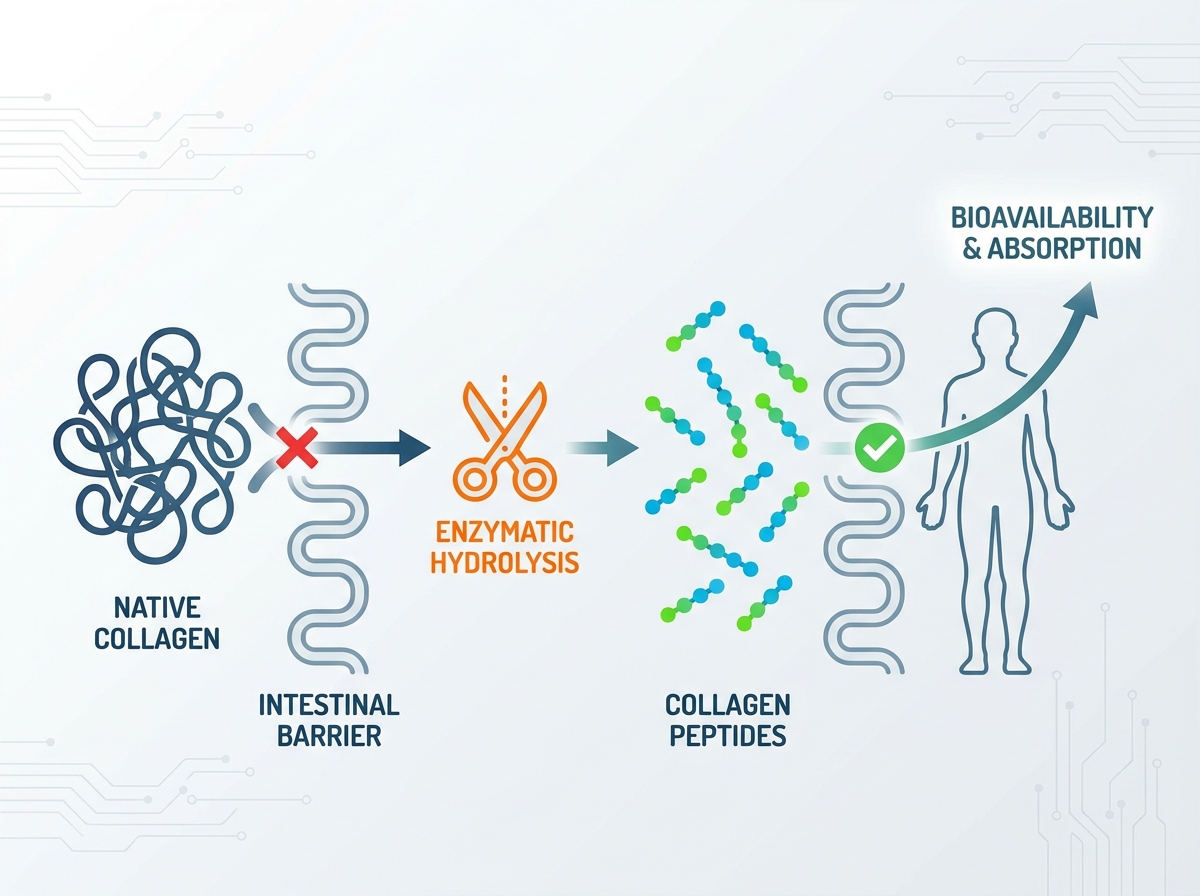
Native collagen is a massive, complex protein molecule. Its sheer size creates a significant physiological problem. The human gastrointestinal tract cannot absorb native collagen efficiently. When you consume raw or unhydrolyzed collagen, your stomach acid treats it like any other dense protein. Your digestive system breaks it apart randomly. You lose the specific amino acid structures required for connective tissue repair. This molecular bottleneck renders standard, unhydrolyzed collagen supplements practically useless for targeted tissue support.
The Peptide Solution
Hydrolysis solves this absorption problem completely. Manufacturers use a specialized enzymatic process to break down the massive native molecules. This targeted breakdown creates very short chains of amino acids. We call these chains peptides. Because they are structurally tiny, they survive stomach acid. They cross the intestinal barrier intact. Once they enter your bloodstream, your body can effectively route them to skin, joints, and bones.
The hydrolysis process typically follows these standardized steps:
Extraction: Manufacturers source raw connective tissues from animal byproducts.
Purification: The raw material undergoes rigorous cleaning to remove impurities and fats.
Enzymatic Breakdown: Specific food-grade enzymes slice the long protein chains into shorter fragments.
Filtration: The liquid undergoes micro-filtration to isolate the active peptide chains.
Drying: The purified liquid is spray-dried into a highly soluble powder.
Bioavailability Metrics
Bioavailability is the ultimate success metric for any supplement investment. It measures how much of the product actually enters your systemic circulation. For collagen, molecular weight dictates bioavailability. Scientists measure this weight in Daltons. Native collagen weighs around 300,000 Daltons. Premium hydrolyzed peptides weigh between 2,000 and 5,000 Daltons. Lower Dalton weight directly correlates with higher intestinal absorption rates. Always look for brands transparently stating their average molecular weight.
Best Practices & Common Mistakes
Best Practice: Always verify the label explicitly states "hydrolyzed" or "collagen peptides."
Common Mistake: Buying products labeled simply as "collagen protein" or "gelatin" while expecting therapeutic skin and joint benefits. Gelatin is only partially broken down and does not offer the same rapid bloodstream absorption.
Evidence-Backed Outcomes vs. Exaggerated Claims
Skin Health & Elasticity
The clinical consensus heavily supports collagen for skin health. However, the mechanism is frequently misunderstood. When you consume peptides, they do not travel directly to your face to fill in wrinkles. Instead, they act as signaling molecules. They stimulate your body's fibroblasts. Fibroblasts are the specific cells responsible for endogenous collagen production. By consuming these fragments, you essentially trick your body into thinking its own collagen is breaking down. This triggers a natural repair response. Studies consistently show increased skin elasticity, better hydration, and reduced wrinkle depth.
Joint & Cartilage Support
Beyond cosmetic benefits, joint health presents the most compelling clinical data. Researchers note moderate-to-strong evidence for joint mobility improvement. Supplementation effectively manages osteoarthritis symptoms over time. Think of this through an active aging lens. As you age, your cartilage degrades faster than your body repairs it. Providing a daily supply of raw structural materials helps close this deficit. Athletes also use these supplements for connective tissue recovery following intense physical training.
The Skeptic’s Lens (What it won't do)
We must set realistic outcome boundaries to establish genuine trust. Consumer marketing often promises the impossible. You must learn to spot these exaggerated claims instantly.
Here is a summary chart separating clinical reality from pure marketing fiction.
Marketing Claim
Clinical Reality
Scientific Explanation
"Targets wrinkles instantly"
False
The body distributes amino acids where they are systemically needed most. You cannot spot-target wrinkles.
"Replaces lost collagen"
Misleading
It does not directly replace it. It stimulates your own cellular mechanisms to produce more endogenously.
"Overnight weight loss"
False
While protein promotes satiety, collagen is not a verified, standalone weight loss catalyst.
"Improves joint mobility"
True
Clinical trials show consistent reduction in joint pain when dosed appropriately over several months.
Decoding Formulation and Sourcing: A Categorical Breakdown
Bovine vs. Marine vs. Porcine
Sourcing dictates the specific types of collagen you consume. Each source offers distinct advantages depending on your primary health goals.
Bovine (Cow): This is the industry standard. It provides a rich mix of Type I and Type III collagen. It is optimal for structural support, skin elasticity, and joint recovery. Look for indicators like "grass-fed" or "pasture-raised" to ensure better farming practices and fewer environmental toxins.
Marine (Fish): Marine sources provide predominantly Type I collagen. Studies suggest marine variations possess slightly higher bioavailability due to smaller average molecule sizes. It is ideal for pure cosmetic focus. However, marine options carry a higher price point. They also present potential allergen risks for those with seafood sensitivities.
Porcine (Pig): Though less common in western consumer supplements, porcine collagen remains highly effective. It closely mimics human collagen structures. It is widely utilized in medical and reconstructive applications.
Source Material
Primary Types
Best Suited For
Price Point
Bovine
Type I & III
Joints, bones, general skin health
Accessible / Moderate
Marine
Type I
Targeted cosmetic skin and hair support
Premium / High
Porcine
Type I & III
Bio-compatibility, general repair
Moderate
The Vegan "Collagen" Caveat
Let us clarify a widespread industry myth. True collagen strictly relies on animal sources. Plants do not naturally produce collagen networks. Any product labeled as "vegan collagen" is technically a misnomer. These plant-based options are actually collagen "boosters." They contain high doses of Vitamin C, trace minerals, and free-form amino acids. They support your internal production mechanisms. However, they do not contain actual peptides. If you follow a strict vegan diet, these boosters are your only option. Just ensure your expectations match the biological reality.
Format Realities
Formulation formats drastically impact both convenience and wallet efficiency.
Powder: This format offers the highest dosing flexibility. It provides the best cost-per-serving ratio on the market. You can easily adjust your daily intake.
Capsules: Capsules offer high convenience for travel. However, they suffer from severe volume limitations. Hitting a clinical 10-gram dose might require swallowing ten large pills daily.
Liquid: Pre-mixed liquids command premium price tags. They often require artificial preservatives to remain shelf-stable. While absorption is slightly faster, the high cost rarely justifies the marginal bioavailability gain.
The Buyer’s Evaluation Framework: How to Shortlist a High-Quality Supplement
Ingredient Purity
Turn the bottle around and read the fine print. The nutrition label should be remarkably boring. It should contain one primary ingredient. You want to see "Hydrolyzed Bovine Collagen Peptides" or a similar singular phrasing. Avoid products hiding behind "proprietary blends." Brands use proprietary blends to mask remarkably low actual peptide dosages. They sprinkle in cheap fillers while claiming premium benefits.
Third-Party Verification
The supplement industry remains loosely regulated in many regions. Heavy metal contamination is a genuine risk when consuming concentrated animal byproducts. You must protect yourself through independent verification. Instruct your buyers to look exclusively for credible testing seals. Look for NSF Certified for Sport, USP, or Informed-Choice labels. These independent organizations verify that the powder contains exactly what the label claims. They also guarantee it remains free from dangerous lead, mercury, or arsenic levels.
Amino Acid Profile Visibility
A credible, trustworthy brand hides nothing. They will transparently list their typical amino acid profile directly on the packaging. You need to verify the concentrations of three specific amino acids. Look for high levels of Glycine, Proline, and Hydroxyproline. These three amino acids form the critical triple-helix structure of human connective tissue. If a brand refuses to disclose its amino acid breakdown, you should immediately disqualify them from your shortlist.
Cost-to-Dose Ratio
Marketing packaging can be highly deceptive. An oversized plastic tub might contain very little active product. You need a reliable framework for calculating actual value. Do not look at the price per container. Instead, calculate the price per gram of active peptides.
Here is a quick calculation method:
Find the total servings per container.
Multiply that by the grams of collagen per serving. (This gives you total active grams).
Divide the total retail price by the total active grams.
This simple math reveals the true cost of your daily habit. It prevents you from overpaying for aggressively marketed, under-dosed containers.
Best Practices & Common Mistakes
Best Practice: Always cross-reference the stated protein content with the collagen content. They should be nearly identical (e.g., 10g collagen = ~9g protein).
Common Mistake: Paying premium prices for "added vitamins" like biotin or hyaluronic acid. These additions are usually severely under-dosed compared to taking them individually.
Implementation Realities: Dosing, Timelines, and Potential Friction
Clinical Dosing Standards
Understanding optimal dosing separates success from failure. The widely accepted effective ranges fall between 2.5 grams and 15 grams daily. The exact number depends heavily on your targeted outcome.
Skin and Cosmetic Support: Clinical trials consistently show visible skin improvements at lower thresholds. A daily dose of 2.5g to 5g is generally sufficient for improving skin elasticity and hydration.
Joint and Bone Recovery: Structural tissues require significantly more raw material. Managing osteoarthritis symptoms or supporting athletic recovery requires higher daily intake. Aim for 10g to 15g daily to see measurable joint mobility improvements.
The Rollout Timeline
Patience is mandatory. You must set the expectation of a delayed return on your supplement investment. Physiological tissue remodeling takes considerable time. Your body turns over cellular structures slowly. You will not see changes in a week. Usually, you need a minimum of 8 weeks of daily use for visible skin elasticity improvements. For joint mobility and deeper connective tissue repair, expect a 12 to 24-week horizon. Consistency matters far more than massive, sporadic doses.
Dietary Integration & Stability
Integrating these powders into your daily routine is surprisingly easy. High-quality hydrolyzed peptides are highly heat-stable. High temperatures do not degrade their clinical efficacy or destroy the amino acid structures. You can seamlessly mix them into hot morning coffee. You can stir them into boiling oatmeal. You can even bake them into muffins or bread. They are typically tasteless and dissolve clear in liquids. This versatility ensures you can maintain the daily consistency required for actual results.
Known Risks & Tolerability
Supplementation remains overwhelmingly safe for the general population. However, we must acknowledge potential friction points. A small percentage of users experience mild, infrequent gastrointestinal distress. Symptoms can include minor bloating, a sensation of fullness, or mild heartburn. We strongly emphasize starting with a lower dose. Begin with just 5 grams daily for the first week. This strategy allows you to assess your personal GI tolerance. You can then gradually titrate up to the full clinical dose of 10 to 15 grams.
Conclusion
Investing in collagen is fundamentally an investment in raw structural materials for your body. It is not a magical cure. It is a biological support mechanism. Efficacy remains entirely contingent on two non-negotiable factors: relentless daily consistency and exceptionally high bioavailability. You now understand why hydrolysis is essential. You know how to bypass deceptive marketing claims. You recognize the vital importance of clinical dosing and realistic timelines.
Your next step is simple. Take your current or prospective supplement bottle. Audit it immediately against our Evaluation Framework. Check the ingredient list for the word "hydrolyzed." Verify the specific animal source. Look for that crucial third-party testing seal. Ensure you are getting at least 10 grams per serving without unnecessary fillers. By demanding transparency and scientific rigor, you secure the best possible outcomes for your long-term health.
FAQ
Q: Can the body absorb collagen peptides without Vitamin C?
A: Yes, your GI tract can readily absorb the broken-down amino acids without Vitamin C. However, they share a critical synergistic relationship. Your body strictly requires Vitamin C to synthesize new endogenous collagen from those absorbed amino acids. Taking them together optimizes your biological repair mechanisms.
Q: Do collagen peptides interfere with other protein supplements?
A: No, they do not interfere. They safely stack with other proteins. However, collagen is an incomplete protein. It entirely lacks the essential amino acid tryptophan. It should safely complement, but never replace, complete protein sources like whey, casein, or comprehensive plant protein blends.
Q: Is there a specific time of day best suited for taking peptides?
A: No specific timing provides a magical advantage. The internet often pushes timing myths. Your body continuously utilizes amino acids for tissue repair around the clock. The absolute best time to take them is whenever you can remember to take them consistently every single day.
Q: What happens if I stop taking them?
A: If you stop supplementing, your tissues will not immediately collapse. However, your body will gradually return to its baseline endogenous production rates. Over several months, the added skin hydration and joint mobility benefits will slowly fade as your natural age-related collagen deficit resumes.