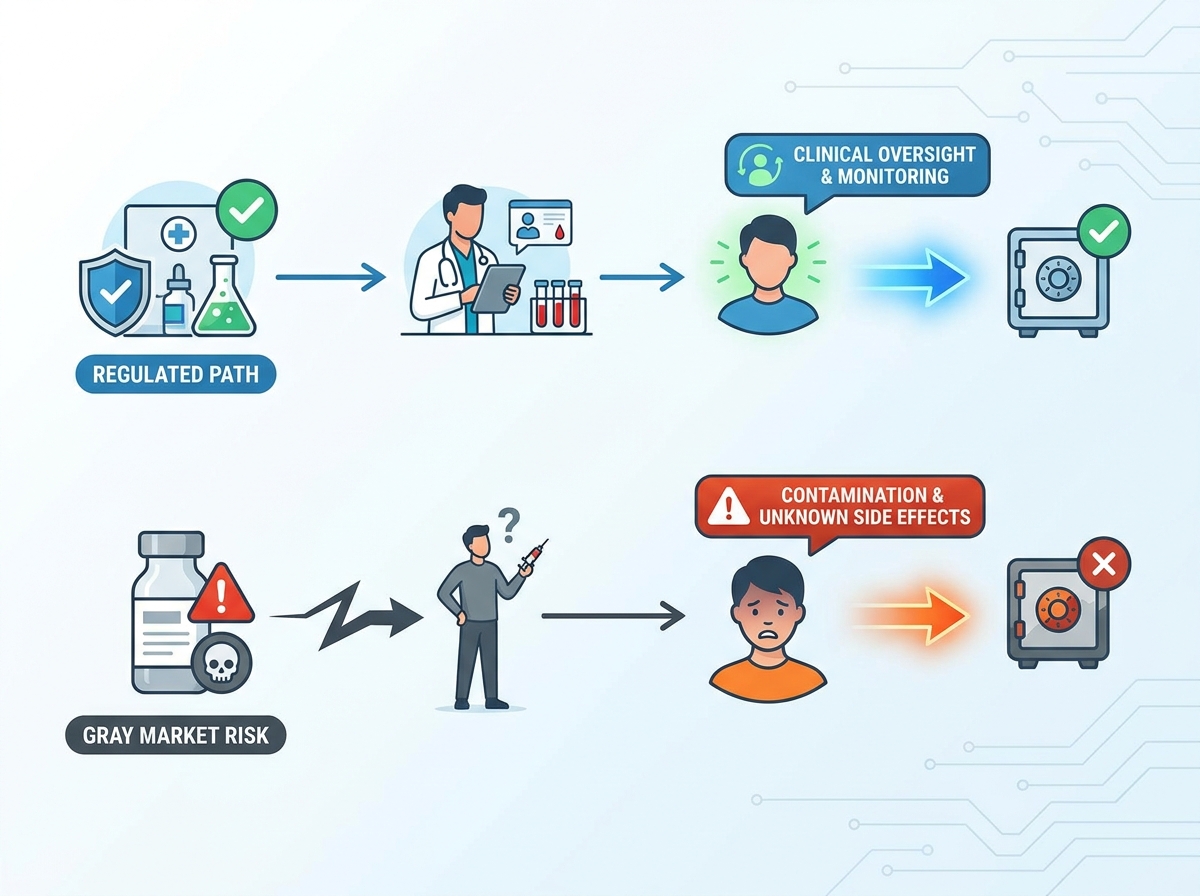
Consumer interest in peptide therapy has surged globally. People actively seek these treatments for weight loss, longevity, and rapid physical recovery. However, regulatory scrutiny is growing just as fast. This creates a confusing landscape for patients. The market is currently flooded with conflicting information. You see clinics aggressively endorsing GLP-1 medications daily. Meanwhile, the FDA continues to crack down on compounding pharmacies and unregulated online vendors.
This stark contrast creates intense friction. You might wonder if these treatments are actually safe. The answer is not a definitive "yes" or "no." Safety depends entirely on the specific molecule, your sourcing strategy, and clinical oversight. We will explore how to navigate this complex medical landscape. You will learn the critical differences between approved medications and experimental options. We will also cover delivery methods, evaluate common risks, and show you how to spot dangerous gray market vendors.
Table of Contents
Toggle
Key Takeaways
Safety is peptide-specific: FDA-approved peptides (e.g., insulin, semaglutide) have established clinical safety profiles, while experimental peptides (e.g., BPC-157) lack rigorous human safety data.
Sourcing dictates risk: The greatest danger in peptide use comes from unregulated, "research-only" online vendors selling contaminated or mislabeled vials.
Medical supervision is non-negotiable: Safe adoption requires baseline bloodwork, precise dosing, and physician monitoring to mitigate side effects.
Delivery methods matter: Injectable peptides bypass the digestive system for higher efficacy but carry elevated risks for infection if hygiene protocols are ignored.
The Safety Spectrum: Framing the Peptide Landscape
To understand the risks, we must first define peptides simply. They are short chains of amino acids linked together. The human body naturally produces over 7,000 of them. Your system uses them as vital signaling molecules. They tell your cells how to function, heal, and regulate metabolism. The current medical safety debate centers entirely on synthetic versions.
FDA-Approved vs. Experimental Peptides
A massive regulatory divide exists in the market today. FDA-approved versions undergo rigorous Phase 1 through Phase 3 clinical trials. These trials involve thousands of human subjects. Researchers meticulously track adverse events, establish safe dosage ranges, and verify long-term efficacy. Insulin was the first major breakthrough in this category.
Contrast this heavily regulated process with "research-grade" options. Many popular compounds exist in a gray area. Laboratories synthesize them for in-vitro or animal studies. They completely lack standardized safety protocols for human use. You take on unknown physiological risks when you use experimental compounds outside of approved clinical settings.
Why the Route of Administration Matters
Safety also shifts based on how you administer the treatment. Oral formulations, topical creams, and subcutaneous injections all carry different risk profiles. Oral versions pass through the digestive system. Stomach acids break them down quickly. This reduces their systemic efficacy but generally keeps safety risks low.
Subcutaneous injections present a different scenario entirely. Injections offer much higher bioavailability. The compound enters your bloodstream directly. This increases therapeutic benefits but introduces new hazards. You face risks of localized site reactions. You also must adhere strictly to sterile techniques. Poor hygiene during injections can lead to severe bacterial infections or abscesses.
Evaluating Solution Categories: Which Peptides Are Clinically Proven?
We can categorize popular peptides by their current evidence base. Medical consensus varies widely depending on the specific application.
Category
Common Examples
Safety Confidence Level
Primary Use Case
Metabolic & Weight Loss
Semaglutid, Tirzepatid
High (FDA Approved)
Obesity, Type 2 Diabetes
Anti-Aging & Growth
Sermorelin, Ipamorelin
Moderate
Hormone Optimization
Healing & Recovery
BPC-157, TB-500
Low to Moderate
Tissue Repair, Sports Injuries
Metabolic & Weight Loss Peptides (GLP-1 Agonists)
GLP-1 agonists currently dominate the medical weight loss industry. Examples include Semaglutid and Tirzepatid. The medical community holds high confidence in their safety profile. They are fully FDA-approved. Doctors rely on extensive long-term clinical data to guide patient care.
These medications mimic natural incretin hormones. They slow gastric emptying and signal fullness to the brain. The side effects are well-documented and generally manageable. Patients frequently experience gastrointestinal issues. Nausea, vomiting, and constipation are common during the initial dose-escalation phase.
Anti-Aging & Growth Hormone Secretagogues
Longevity clinics frequently prescribe growth hormone secretagogues. Common examples include Sermorelin and Ipamorelin. Their safety profile merits moderate confidence. Doctors generally consider them safer than synthetic Human Growth Hormone (HGH) injections.
They work through a unique mechanism. They stimulate your pituitary gland to produce its own natural growth hormone. They do not replace the hormone entirely. This preserves your body's natural feedback loop. However, safe use requires strict dosage control. Poor management can lead to endocrine disruption or unwanted fluid retention.
Healing & Recovery Peptides
Sports medicine communities heavily utilize healing compounds like BPC-157 and TB-500. They use them off-label to accelerate tissue repair. The safety profile here sits at low to moderate confidence. Most evidence comes from animal studies or anecdotal human reports.
These compounds lack large-scale human safety trials. Consequently, the FDA recently flagged BPC-157. They placed compounding restrictions on it. The agency cited a lack of sufficient safety data for general pharmacy production. You must weigh the healing benefits against the lack of long-term human data.
Key Evaluation Dimensions: Known Risks and Side Effects
No medical intervention is entirely without risk. We must take a transparent, evidence-based look at adverse effects. Exaggerated claims of complete safety often mislead desperate patients.
Common and Manageable Side Effects
Most patients experience mild reactions as their bodies adjust to the therapy. These reactions rarely require emergency medical intervention. You can manage them easily through dosage adjustments.
Injection site reactions: Mild redness, itching, or swelling frequently occurs at the subcutaneous injection site.
Gastrointestinal distress: Nausea and temporary appetite loss are highly prevalent, especially during the first few weeks of GLP-1 therapy.
Neurological symptoms: Mild headaches often arise due to changes in blood sugar or hydration levels.
Fluid retention: Certain growth-stimulating molecules cause temporary water weight gain in the extremities.
Severe Risks and Contraindications
You must also understand the severe risks associated with these therapies. Immunogenicity is a major concern. Sometimes, your body recognizes the synthetic chain as a foreign invader. Your immune system then creates antibodies against it. This neutralizes the therapy and potentially causes allergic reactions.
Tumor acceleration is another critical risk factor. Growth-stimulating therapies do not necessarily cause cancer directly. However, they can potentially accelerate the growth of pre-existing tumors. You must also monitor cardiovascular strain. Some therapies can increase resting heart rate or alter blood pressure dynamics over time.
Specific Demographic Risks (Older Adults & Pre-existing Conditions)
Older adults face unique safety considerations. Aging affects how organs process medications. Kidney and liver clearance rates slow down as you age. This delayed clearance can cause the medication to build up in the bloodstream. Older patients require lower starting doses and closer monitoring.
Pre-existing conditions dictate strict contraindications. Some individuals should absolutely avoid specific treatments. For example, anyone with a personal or family history of medullary thyroid cancer must avoid GLP-1 agonists. The FDA places black box warnings on these medications for this specific reason.
Implementation Risks: The Danger of the "Gray Market"
The core danger often lies not in the molecule itself, but in the supply chain. Shifting our focus to sourcing is crucial. Sourcing is the most important decision-stage differentiator for your safety.
Pharmaceutical Grade vs. "For Research Purposes Only"
A dangerous legal loophole exists online. Vendors sell unverified peptides directly to consumers. They label the vials "For Research Purposes Only." They explicitly state the products are not for human consumption. This allows them to bypass FDA oversight completely.
The risks here are catastrophic. These vendors sell lyophilized powders without proper quality control. Independent testing frequently reveals dangerous impurities. Vials may contain heavy metals or incorrect molecular structures. Bacterial contamination is also a severe threat. Unsterile manufacturing leaves endotoxins in the powder. Injecting endotoxins can trigger a massive immune response or sepsis.
The Role of Compounding Pharmacies
Legitimate therapies often come from compounding pharmacies. You need to understand how these facilities operate. The FDA classifies them as either 503A or 503B facilities. 503A pharmacies compound medications for specific patient prescriptions. 503B facilities act as larger outsourcing facilities for hospitals and clinics.
Recent regulatory shifts have tightened rules around compounding. The FDA routinely inspects these facilities for sterility and quality control. Patients must verify their provider uses state-licensed, FDA-regulated facilities. Avoid any clinic prescribing compounds mixed in unregulated environments.
Shortlisting Providers: How to Safely Start Peptide Therapy
Finding a legitimate medical provider is your first line of defense. You need a clear, actionable approach when evaluating longevity clinics or functional medicine practitioners.
Required Clinical Protocols
Legitimate clinics follow strict diagnostic protocols. They will never prescribe injectable therapies blindly. Comprehensive baseline blood panels are an absolute requirement. These tests ensure your organs can handle the therapy.
Your doctor should test your metabolic function and baseline hormone levels. They must evaluate thyroid function thoroughly. Tumor marker screening is also essential before starting any growth secretagogue. Ongoing bloodwork allows the physician to monitor your progress and catch adverse reactions early.
Red Flags to Avoid During Evaluation
You must remain vigilant during the consultation phase. Many predatory clinics prioritize profit over patient safety. Watch out for these critical warning signs.
No physician consultation: Run away if a website allows you to add injectable therapies to a cart without speaking to a doctor.
Aggressive bulk discounts: Medical treatments are not wholesale commodities. Deep discounts often indicate expired or low-quality sourced vials.
Guarantees of "miracle" results: Legitimate doctors discuss realistic outcomes. They never promise overnight anti-aging miracles or effortless weight loss.
Overseas shipping: Avoid providers shipping unprescribed, unlabeled vials directly from international manufacturing hubs.
Conclusion
Are these therapies safe? Yes, provided you meet several critical conditions. You must choose heavily researched molecules. You must source them exclusively from regulated, state-licensed compounding pharmacies. Most importantly, you must administer them under strict, ongoing medical supervision.
Do not compromise your health by searching for cheap alternatives online. The gray market presents unacceptable risks. It is time to step away from DIY online research. Schedule a formal consultation with a board-certified endocrinologist or a specialized functional medicine doctor. They will order the necessary baseline bloodwork. They can then establish a personalized, data-driven treatment plan tailored perfectly to your biology.
FAQ
Q: Are peptides safe for kidneys and liver?
A: They are generally safe, but baseline testing is crucial. Your liver and kidneys process and clear these molecules from your bloodstream. If you have pre-existing renal or hepatic impairment, the clearance rate slows down. This can cause the compound to accumulate, increasing side effects. Always require a comprehensive metabolic panel before starting.
Q: Why did the FDA ban BPC-157?
A: The FDA did not issue a blanket ban on the molecule itself. Instead, they moved it to the Category 2 list for compounding restrictions. This prevents compounding pharmacies from producing it for general use. The FDA made this decision because BPC-157 currently lacks the large-scale human safety trials required to prove its long-term safety.
Q: Can peptide therapy cause cancer?
A: These therapies do not directly mutate cells to cause cancer. However, growth hormone secretagogues stimulate cellular proliferation. If you already have an undiagnosed tumor, these specific therapies can theoretically accelerate its growth. This is why thorough clinical screening and tumor marker blood panels are strictly required beforehand.
Q: Are oral peptides as safe as injectable peptides?
A: Oral formulations generally present lower systemic risks than unsterile injections. However, they suffer from poor efficacy. The acids in your gastrointestinal tract rapidly degrade the amino acid chains before they enter your bloodstream. Injections bypass the gut for higher bioavailability, but they carry elevated risks for localized infections if you ignore sterile techniques.