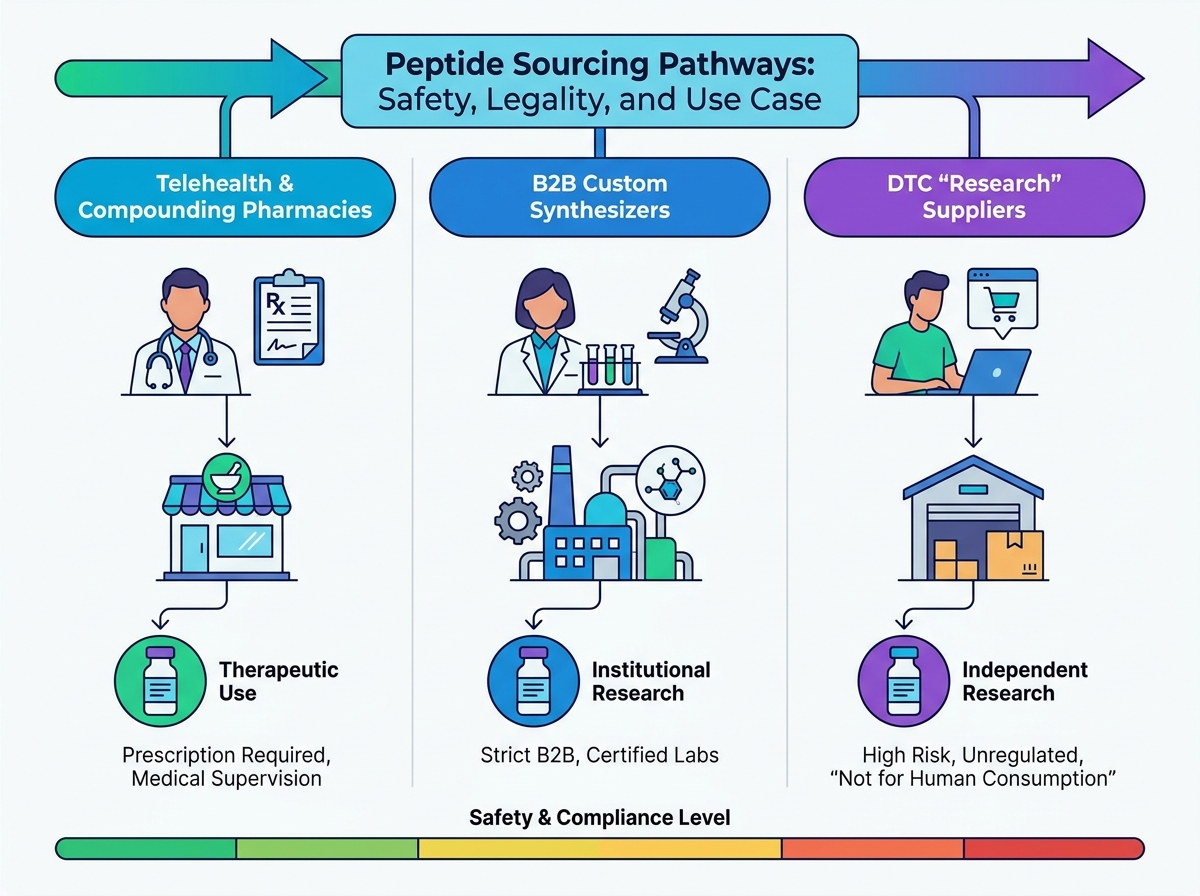
The market for peptides is highly fragmented today. It straddles the lines between pharmaceutical therapeutics, cosmetic applications, and strictly regulated laboratory research. Because the barrier to entry for online vendors is low, buyers face a confusing landscape. This landscape is flooded by unverified suppliers, varying purity standards, and complex regulatory gray areas. Making a poor sourcing decision carries severe consequences. You might experience significant health risks or ruin expensive laboratory experiments. This guide breaks down the verifiable pathways to sourcing these compounds safely. We outline the strict quality criteria required for proper vendor evaluation. You will also learn the critical red flags separating legitimate providers from high-risk operations.
Key Takeaways
Intent dictates the source: Human therapeutics require medical prescriptions and compounding pharmacies, whereas academic/lab applications rely on certified B2B custom synthesis.
Verification is non-negotiable: Legitimate peptide acquisition requires vendor transparency, specifically batch-specific Certificates of Analysis (COAs) and third-party HPLC/MS testing.
Understand the "Research Only" label: Vendors selling "research chemicals" direct-to-consumer often operate in regulatory gray areas; buyers must critically evaluate their quality control infrastructure.
Purity does not equal safety: Even >99% pure peptides require proper storage (lyophilization, cold chain) and sterile reconstitution protocols to remain viable.
The Landscape: Understanding Peptide Classifications and Regulations
The primary risk in acquiring these compounds involves misaligning the product grade for your intended use case. Buying the wrong grade leads to compliance failures. It can cause immense financial loss. It also introduces critical health risks for end-users. You must first understand how regulatory bodies classify these products.
Pharmaceutical vs. Research Grade
Pharmaceutical-grade products undergo intense scrutiny. The FDA or regional equivalent bodies regulate them heavily. Facilities manufacturing these compounds must remain GMP-compliant (Good Manufacturing Practice). They are bound by strict distribution laws. Human applications demand this rigorous biological safety testing. Every batch requires sterile processing environments to eliminate contamination.
Research-grade options exist strictly for in-vitro lab use. Academic institutions rely on them for cellular assays. They often lack the rigorous biological safety testing required for human applications. High-tier B2B synthesizers do maintain rigorous chemical purity. However, chemical purity does not guarantee biological sterility. You should never substitute research-grade products for clinical therapeutic needs.
Cosmetic and OTC Supplements
The consumer market utilizes topical and oral formats heavily. Cosmetic formulations rely on specific structural modifications. Liposomal delivery systems represent one common adaptation. These modifications help the product bypass strict medical regulations. The FDA regulates them as cosmetics rather than drugs. They often suffer from severe bioavailability limitations. Your body struggles to absorb oral peptides because digestive enzymes break them down rapidly.
Peptide Classification Summary Chart
Classification
Regulatory Body
Primary Application
Purity & Safety Standard
Pharmaceutical Grade
FDA / EMA
Human Therapeutics
Sterile, GMP-compliant, Biologically Safe
Research Grade
None (Self-regulated)
In-Vitro Lab Use
High Chemical Purity, Non-Sterile
Cosmetic Grade
FDA (Cosmetic Division)
Topical Skincare
Safe for Topical Use, Low Bioavailability
Solution Categories: 3 Pathways to Get Peptides
Pathway 1: Telehealth Clinics and Compounding Pharmacies
This pathway serves individuals seeking therapeutic outcomes specifically. Common goals include metabolic support or tissue repair. The mechanism requires a clinical consultation first. You must complete comprehensive bloodwork. A licensed doctor must issue a formal prescription. Regulated 503A or 503B compounding pharmacies then prepare the medication.
This route offers the highest safety and legal compliance. You know exactly what enters your body. The pharmacy tests every batch for sterility and endotoxins. The main drawbacks include higher financial costs. Access remains strictly restricted to medically approved indications. You cannot buy these products for off-label self-experimentation legally.
Pathway 2: B2B Custom Peptide Synthesizers
Academic institutions use this pathway predominantly. Biotech startups and clinical research organizations also rely on it. Procurement happens directly through established biotechnology supply chains. These vendors offer custom sequencing and complex structural modifications. They also produce high-volume libraries for drug discovery.
This pathway gives you absolute control over the sequence. You dictate the exact purity requirements. However, it requires verified institutional credentials. Vendors will reject individual buyers immediately. Purchasing these materials for personal consumption is strictly prohibited. B2B synthesizers flag suspicious residential addresses during the vetting process.
Independent researchers often utilize this final pathway. It represents the highest risk category by far. The mechanism involves simple e-commerce storefronts. They sell lyophilized vials under a strict "Not for Human Consumption" banner. Buyers simply add items to a cart and check out.
These sites remain highly accessible. They offer much lower costs compared to compounding pharmacies. Unfortunately, quality varies wildly between vendors. You face a high risk of molecular degradation during shipping. Zero regulatory oversight exists here. You must rely entirely on your own auditing skills to verify safety.
Evaluation Dimensions: How to Vet a Peptide Vendor
Third-Party Analytical Testing (The Gold Standard)
Verification remains the most critical aspect of procurement. You must demand third-party analytical testing from any vendor. In-house testing holds little value due to obvious conflicts of interest. The best vendors publish independent lab results openly.
HPLC (High-Performance Liquid Chromatography): This test verifies the purity percentage. You should look for results showing greater than 98% or 99% minimum purity. HPLC separates the components within the mixture. It quantifies exactly how much target compound exists versus impurities.
Mass Spectrometry (MS): This confirms the exact molecular weight. It verifies the identity of the specific sequence. If the mass does not match the theoretical weight, the synthesis failed.
TFA (Trifluoroacetic Acid) Removal: Synthesis processes rely heavily on TFA. Residual TFA causes severe toxicity during cellular assays. Ensure the vendor lists TFA removal as an essential criteria for sensitive in-vivo research.
Facility and Compliance Credentials
You should investigate the actual laboratory environment. Look for ISO 9001 certification specifically. You might also look for cGMP (Current Good Manufacturing Practice) compliance. These certifications signal standardized quality management. They prove the facility maintains calibrated equipment. They demonstrate proper sanitation protocols. Without these certifications, contamination risks multiply exponentially.
Transparency and Documentation
Review the provided Certificates of Analysis (COAs) thoroughly. You must ask whether the COAs are batch-specific or generic. Generic COAs serve as useless marketing props. Legitimate vendors test every single synthesized batch. They provide the name of the independent testing laboratory. They also provide direct contact info for that laboratory. This allows you to verify the document's authenticity independently.
Implementation Risks and Common Red Flags
The "Proprietary Blend" Evasion
Avoid vendors masking dosages behind proprietary blends. You will see this often in the OTC supplement market. Brands hide their exact sequence ratios to "protect trade secrets." This makes verifying concentration completely impossible. It also prevents you from calculating an effective dose. True scientific suppliers list exact milligram counts for every active component.
Inadequate Cold Chain Logistics
Temperature stability impacts molecular integrity drastically. peptides in liquid form degrade rapidly at room temperature. Vials should always arrive lyophilized. This freeze-dried state stabilizes the delicate chemical bonds. If a vendor ships liquid formats, they must use validated temperature controls. Dry ice or specialized cooling packs are mandatory. Receiving warm liquid vials guarantees a degraded, useless product.
Payment and Support Anomalies
Financial processing methods reveal a lot about operational legitimacy. Be highly skeptical of vendors accepting only untraceable cryptocurrencies. Offshore wire transfers represent another massive red flag. Legitimate businesses secure traditional merchant processing accounts. They also offer robust customer service channels. If you cannot reach a human representative by phone, do not place an order.
Exaggerated Medical Claims
Pay close attention to the marketing language used. E-commerce sites legally selling "research materials" cannot make therapeutic claims. They cannot promise weight loss or muscle growth. Doing so violates regulatory statutes immediately. It indicates a complete lack of operational compliance. Regulators shut down these non-compliant vendors frequently. You do not want your capital tied up in a seized operation.
Shortlisting Logic and Next-Step Actions
Step 1: Define the Use Case Matrix
Your first action requires defining your specific needs clearly. This dictates your entire procurement path.
If you require materials for health or therapeutic use, stop looking at research sites. You must book a consultation with a licensed therapy clinic. You can also consult an endocrinologist directly.
If you operate an institutional lab, ignore direct-to-consumer storefronts. You should request quotes from verified institutional synthesizers. Always request sample COAs and specific lead times during your initial inquiry.
Step 2: The Audit Phase
Once you shortlist potential vendors, initiate the audit phase. You must cross-reference the vendor's provided COAs. Locate the stated third-party lab on the document. Find their official phone number online. A quick phone call to the testing lab verifies everything. They will tell you if the COA is forged or legitimate. Many shady vendors photoshop dates and batch numbers on old COAs.
Step 3: Pilot Purchasing
Never place a bulk order initially. For research applications, always initiate a small-batch order first. This acts as a practical stress test for the vendor. You can independently test the material's solubility upon arrival. You can verify the delivery speed and packaging quality. This pilot phase protects your main budget before committing to bulk institutional synthesis.
Vendor Vetting Action Plan
Phase
Action Item
Success Metric
Initial Screening
Check for ISO/GMP certifications
Visible credentials on website
Data Audit
Call third-party testing lab
Lab confirms COA authenticity
Pilot Test
Order minimum viable quantity
Properly lyophilized upon arrival
Acquiring peptides safely is an exercise in rigorous vetting. Whether you navigate the medical route via compounding pharmacies or source high-fidelity sequences for laboratory research, your decision hinges on verifiable data. You must demand batch-specific analytical testing from every supplier. You must understand legal classifications to avoid compliance issues. Reject opaque marketing and proprietary blends immediately. By following these strict protocols, you can confidently secure high-quality materials tailored to your precise scientific or medical requirements.
FAQ
Q: Is it legal to buy peptides online?
A: Yes, but legality depends entirely on intent and classification. Buying cosmetic formulations or institutional research batches is legal. Buying prescription-only therapeutics without a valid prescription violates regulatory statutes. Using research chemicals for human consumption also violates federal regulations.
Q: What is a peptide COA, and why does it matter?
A: A Certificate of Analysis (COA) is a formal lab report. It details the precise purity, molecular weight, and structural identity of a specific batch. Without a verifiable, third-party COA, you have absolutely no proof regarding what is actually inside the vial.
Q: Do peptides need to be refrigerated during shipping?
A: Lyophilized (freeze-dried) powder remains generally stable at room temperature for short transit periods. You should store it in a freezer for long-term preservation. Reconstituted liquid formats must maintain a strict cold chain to prevent rapid molecular degradation.
Q: How do compounding pharmacies differ from research websites?
A: Compounding pharmacies are highly regulated entities. They prepare sterile, patient-specific medications strictly under a licensed doctor's order. Research websites sell unregulated, non-sterile chemicals intended solely for in-vitro laboratory experiments.