At the core of every life process and modern synthetic therapeutic lies the peptide bond. This foundational covalent linkage bridges amino acids to form intricate biological molecules. Moving past textbook definitions, mastering this chemical connection directly dictates commercial success in biotechnology. Natural protein synthesis operates flawlessly within the cellular ribosome, achieving remarkable efficiency. Conversely, artificially replicating these bonds at scale introduces massive engineering hurdles. Yield drops, purity compromises, and stability failures routinely plague laboratory setups and commercial manufacturing lines alike. You must understand the chemical realities of bond formation and cleavage to accurately evaluate synthesis methodologies. We will explore how structural rigidity impacts analytical validation and formulation strategies. Ultimately, these practical insights will guide you in selecting highly capable manufacturing partners for custom peptides.
Table of Contents
Toggle
Key Takeaways
Structural Rigidity: Peptide bonds exhibit partial double-bond character, dictating the stability and 3D conformation of synthetic therapeutics and reagents.
Synthesis Bottlenecks: Condensation reactions in laboratory environments (like SPPS) require rigorous optimization to prevent truncated sequences and aggregation.
Analytical Imperatives: Validating bond integrity requires robust chromatographic and spectrometric testing (HPLC, MS) to ensure research or clinical-grade purity.
Partner Selection: Moving from concept to commercialization demands a synthesis partner evaluated on scalability, QA/QC transparency, and risk mitigation strategies.
The Biochemical Foundation: Structure and Stability
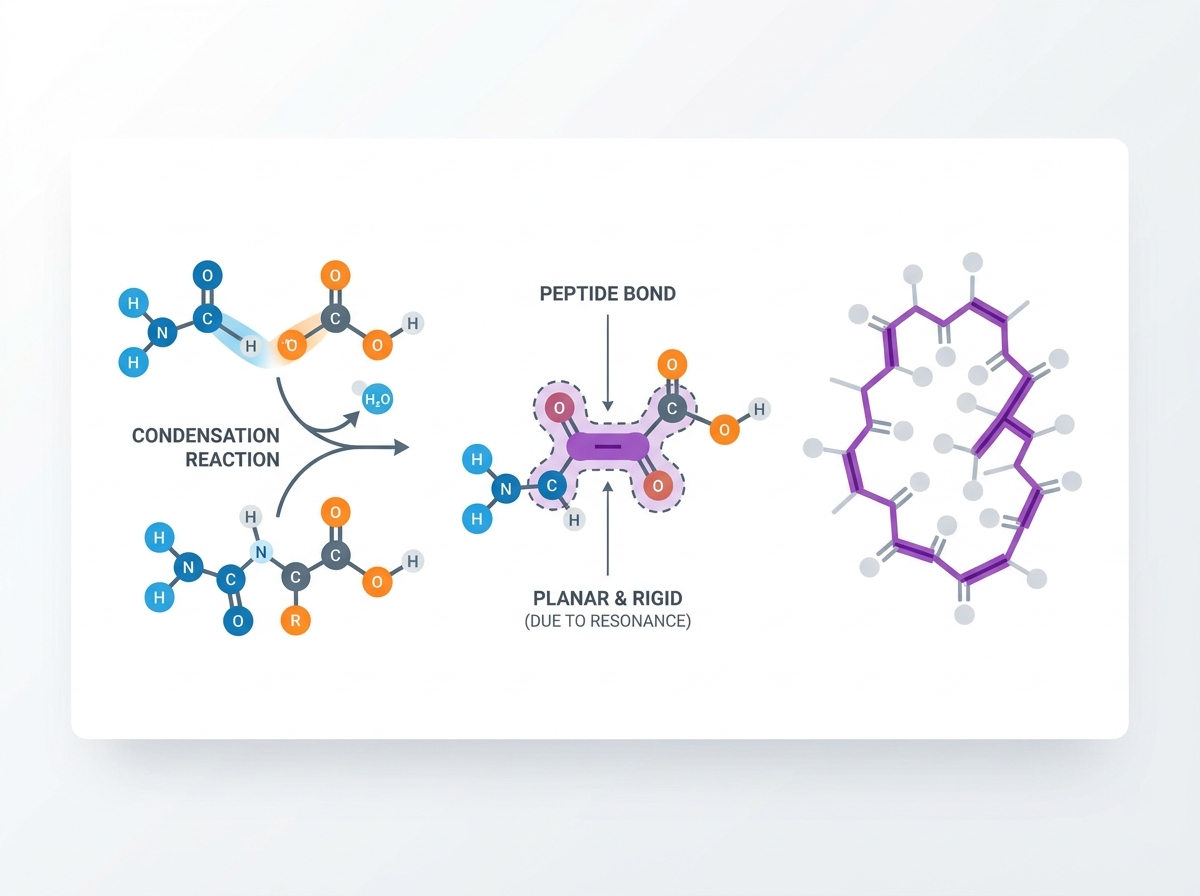
Biological systems build complex proteins through a precise dehydration synthesis reaction. The carboxyl group of one amino acid reacts directly in this process. It bonds to the amino group of an adjacent amino acid. This specific chemical reaction releases a single water molecule as a byproduct. The resulting covalent connection forms the primary backbone of all peptides. It acts as the fundamental structural scaffold holding life together. We call this specific linkage an amide bond. Chemists have studied its unique properties for decades to understand drug design.
The carbon-nitrogen bond is not a simple single bond. Electrons delocalize continuously across the oxygen, carbon, and nitrogen atoms. This electron sharing creates a distinct resonance structure. The bond gains a partial double-bond character. It cannot rotate freely in space. The six atoms involved remain permanently locked in a rigid, planar geometry. Trans configuration is highly favored naturally. This prevents severe steric clashes between neighboring bulky side chains. Proline represents a rare exception where cis configurations occur. This geometric lock fundamentally restricts molecular flexibility.
Why does this inherent rigidity matter so much? It directly impacts the design and success of synthetic therapeutics. The lack of rotation enforces specific three-dimensional conformations. These predictable shapes determine cell receptor binding affinity. Rigidity also shields the molecular backbone from rapid enzymatic degradation. It extends the functional shelf-life of commercial pharmaceutical formulations. When researchers design synthetic compounds, they rely heavily on this predictable geometry. The planar nature dictates overall in vivo bioavailability. If the bond were fully flexible, targeted drugs would fail to lock into cellular receptors accurately.
Requires specific energy input, complicating synthetic scale-up.
Formation and Cleavage: Mechanisms Impacting Yield
Biological translation utilizes the cellular ribosome perfectly. This biological machinery is incredibly efficient and highly regulated. It strings together amino acids effortlessly in aqueous environments. Chemical synthesis operates very differently in a laboratory setting. Solid-Phase Peptide Synthesis (SPPS) serves as the modern commercial standard. It requires complex synthetic coupling reagents like HATU or DIC. We must protect specific functional groups initially. Common protecting groups include Fmoc or Boc chemistries. Then, we selectively deprotect them using mild bases or acids. This aggressive cycle repeats for every single amino acid added. The chemical realities dictate strict anhydrous environmental controls. We must force a reaction biological systems perform naturally.
Vulnerabilities exist despite the inherently strong covalent nature. Cleavage, often driven by hydrolysis, remains a constant industrial threat. Certain environmental conditions accelerate this chemical degradation rapidly. You must anticipate these breakdown pathways during formulation.
Evaluating these stability limits requires highly objective criteria. You cannot formulate commercial products blindly. Cleavage risks dictate strict storage protocols globally. For example, lyophilized powders require continuous sub-zero temperatures. Aqueous formulations demand highly specific buffering agents. Packaging materials must actively block moisture and UV light. These rigid constraints directly impact commercial viability and shipping logistics. If a backbone bond breaks prematurely, the entire therapeutic loses efficacy. Regulatory agencies like the FDA demand exhaustive, multi-year stability data. You must prove the backbone remains perfectly intact over time.
Analytical Methods: Identifying and Validating Peptide Bonds
Quality control presents a massive challenge for molecular manufacturing. You must prove structural integrity definitively before any application. Differentiating the target molecule from synthesis byproducts is notoriously difficult. Truncated sequences closely mirror the final desired product physically. Deletion impurities hide easily within complex chemical mixtures. A single missing linkage ruins the entire sequence. You need robust, highly specialized analytical methods to verify success.
Analytical Method
Primary Function
Target Validation Parameter
Output Format
HPLC
Chromatographic Separation
Overall sequence purity
Peak chromatogram
Mass Spectrometry
Ion Mass Measurement
Exact molecular weight
Mass-to-charge graph
NMR Spectroscopy
Magnetic Resonance Imaging
Secondary structure confirmation
Chemical shift spectra
FTIR Spectroscopy
Infrared Light Absorption
Amide bond presence
Absorption peaks
High-Performance Liquid Chromatography (HPLC) remains the universal gold standard. It separates compounds based entirely on hydrophobicity. HPLC isolates the full-length target from shorter truncated impurities. It gives you a clear, objective purity percentage. Mass Spectrometry (MS) verifies the exact molecular weight directly. ESI and MALDI-TOF represent the most common techniques used. MS provides crucial sequence confirmation instantly. It ensures every amino acid linked correctly during synthesis. It spots tiny mass discrepancies caused by missing protecting groups easily.
Nuclear Magnetic Resonance (NMR) and Fourier Transform Infrared Spectroscopy (FTIR) validate deeper elements. They confirm the specific amide bond presence definitively. They help researchers map out secondary structures accurately. These tools detect alpha-helices or beta-sheets forming within the chain. Data interpretation is absolutely critical for raw material buyers. When reviewing a manufacturer's Certificate of Analysis (CoA), look closely. Demand clearly verifiable HPLC chromatograms showing sharp peaks. Ensure the MS data matches the theoretical calculated mass exactly. Vague CoAs signal potential manufacturing flaws or hidden impurities. You need empirical proof of product quality before proceeding.
Overcoming Scalability Challenges in Peptide Synthesis
Scaling chemical production introduces severe laboratory bottlenecks globally. Yield drops off dramatically in exceptionally long sequences. Coupling failures compound rapidly with every added amino acid. The mathematical reality of sequential synthesis is unforgiving.
A 99% coupling efficiency per step yields approximately 60% purity over 50 steps.
A 95% efficiency drops overall overall sequence yield to merely 7%.
Truncated failure chains become chemically indistinguishable from the final target mass.
Steric hindrance further complicates large-scale synthesis efforts. Bulky side chains physically block the active reaction site. Aggregation occurs frequently in highly hydrophobic sequences. The growing chemical chain folds backward onto itself. This folding completely hides the reactive amino group. Standard coupling reagents cannot penetrate the dense aggregated mass. To overcome this, chemists use specialized organic solvents. They introduce powerful chaotropic agents to disrupt hydrogen bonding. Sometimes, they apply controlled microwave heating to force chains apart. Researchers often substitute pseudo-prolines to prevent this premature folding entirely.
Scaling also forces difficult, pragmatic financial decisions. You face constant cost versus purity trade-offs daily. Achieving ultra-high 99% purity requires extensive HPLC purification runs. This specific process consumes massive amounts of expensive, hazardous solvents. It also sacrifices significant raw material yield during separation. Clinical in vivo applications demand this rigorous purification unconditionally. In contrast, basic in vitro research applications might tolerate 85% purity safely. You must actively balance financial realities against strict experimental requirements. Choosing the wrong purity grade ruins budgets and compromises critical data.
Shortlisting Logic: How to Evaluate a Peptide Manufacturing Partner
Moving from a theoretical concept to full commercialization requires strategic partnerships. You must assess technical capabilities thoroughly before signing contracts. Can the chosen vendor handle exceptionally difficult sequences? Look for verified experience with unnatural amino acids. Check their physical ability to synthesize constrained cyclic structures. Determine if they use solid-phase or liquid-phase methodologies primarily. LPPS often works better for very short, high-volume commercial sequences. SPPS handles longer, highly complex research sequences better. The vendor must align their technology with your specific molecule.
Quality assurance distinguishes reputable partners from basic synthesis labs. Research-grade manufacturing differs vastly from strict cGMP compliance. Current Good Manufacturing Practices require rigid environmental controls. The vendor must maintain documented Standard Operating Procedures (SOPs) continually. They need dedicated, heavily monitored cleanrooms for production. Environmental air quality monitoring must run continuously without interruption. You should request formal audit reports detailing their facility compliance standards.
Data transparency is entirely non-negotiable for serious buyers. Establish baseline reporting expectations early in discussions. Demand raw analytical reporting delivered with every single batch. Verifiable HPLC traces and MS spectra are strictly mandatory. Ask for comprehensive sequence confirmation data upfront. If a vendor hesitates to share raw analytical data, walk away immediately. It usually indicates systemic quality control failures.
Evaluate risk mitigation strategies and typical turnaround times. Synthesis failures happen frequently in complex chemistry. A excellent partner communicates these technical issues immediately. They optimize challenging coupling steps proactively without prompting. They adjust internal protocols aggressively to meet strict project timelines. They accomplish this without ever sacrificing final product purity. A strong vendor history successfully predicts future production reliability. You need a highly communicative partner who navigates chemical hurdles expertly.
Conclusion
Mastering the fundamental chemistry of the peptide bond is merely the starting baseline. Translating that delicate chemistry into reliable, scalable production represents the true commercial challenge. We have explored how structural rigidity dictates both stability and biological function. We examined why sequential synthesis introduces unavoidable mathematical yield drops.
Robust analytical verification remains your strongest defense against degradation and synthesis failure. Strategic vendor partnerships mitigate the massive risks inherent in chemical scale-up. As a technical buyer or researcher, you must demand absolute transparency. Audit your current synthesis protocols against modern analytical standards. Request detailed technical consultations for any sequences exceeding thirty residues. Review sample CoAs critically before committing to large-scale custom manufacturing agreements.
FAQ
Q: How does a peptide bond differ from a standard amide bond?
A: While all peptide bonds are technically amide bonds, they exist specifically within the biological context of alpha-amino acids. They link the alpha-carboxyl group of one amino acid to the alpha-amino group of another. This specific biological arrangement creates unique resonance stabilization, forcing a rigid, planar geometry essential for protein folding.
Q: What is the primary cause of peptide bond degradation during storage?
A: Hydrolysis is the primary cause of structural degradation. Moisture acts as the catalyst, severing the covalent linkage. This reaction accelerates significantly during extreme pH fluctuations, exposure to high temperatures, or when accidental microbial contamination introduces unregulated proteolytic enzymes into the storage environment.
Q: Why do synthesis yields decrease exponentially as peptide chains get longer?
A: Synthesis requires sequential addition. If every coupling step operates at 99% efficiency, the 1% failure rate compounds mathematically. Over 50 consecutive steps, the overall yield drops to roughly 60%. Steric hindrance and chain aggregation further block active sites, ensuring incomplete coupling reactions as the chain lengthens.
Q: What data should I require to prove the structural integrity of a custom peptide?
A: You must demand a Certificate of Analysis featuring paired analytical reports. Require high-resolution HPLC chromatograms to prove overall sample purity and identify truncated impurities. Simultaneously, require Mass Spectrometry (MS) data to verify the exact molecular weight, ensuring sequence accuracy and correct protecting group removal.