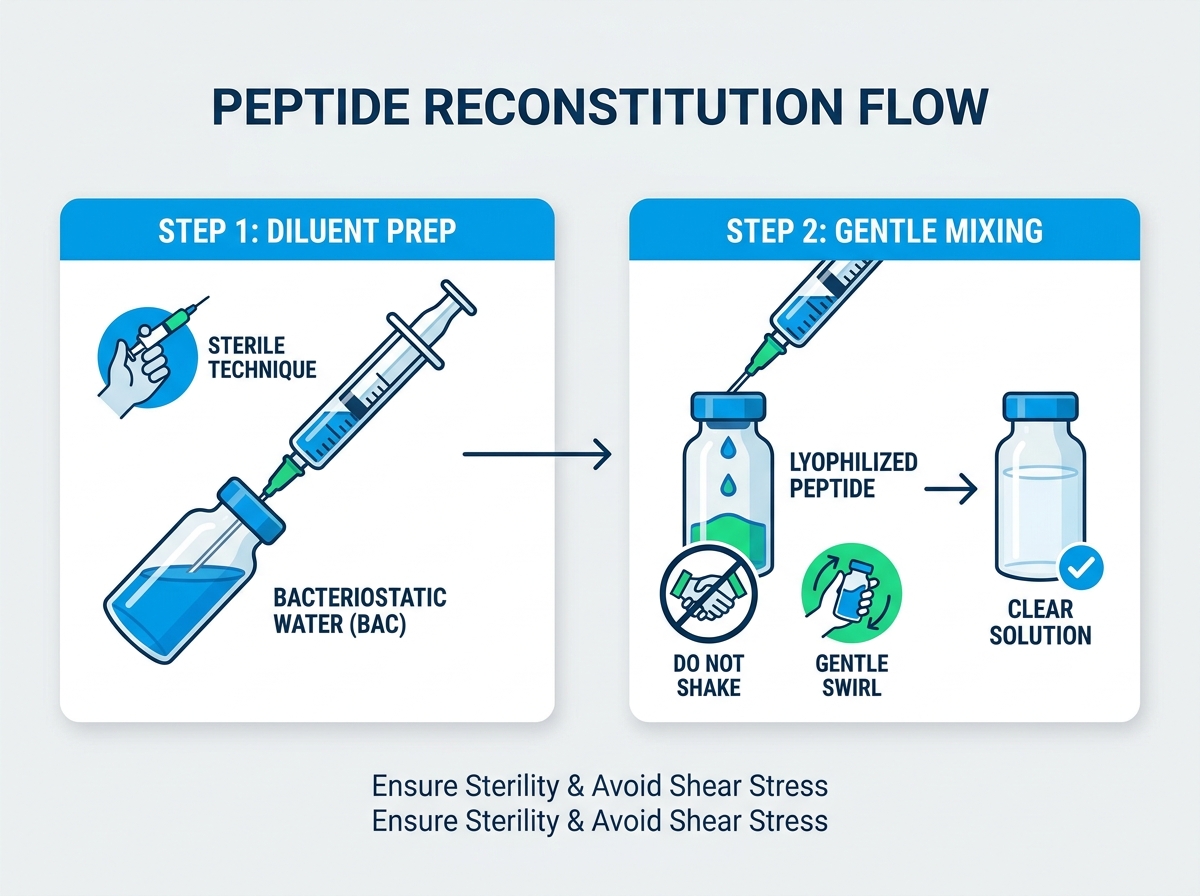
Lyophilized, or freeze-dried, peptides require incredibly precise reconstitution to function effectively. Improper handling often leads to rapid degradation, a complete loss of efficacy, and a wasted investment in valuable materials. Reconstitution is the essential process of adding a liquid diluent to a dry powder to create a stable, usable solution. This step bridges the gap between dormant chemical structures and active biological compounds. If you rush this protocol or use the wrong solvent, you risk destroying delicate molecular bonds permanently before they even reach the testing phase. In this comprehensive guide, you will learn the exact standardized protocols for safely mixing and storing these compounds to maximize their longevity. We cover everything from diluent selection and sterile preparation to accurate dosing calculations. Disclaimer: The protocols outlined below are strictly for educational, research, or prescribed laboratory application purposes only.
Table of Contents
Toggle
Key Takeaways
Sterility is non-negotiable: Implementing clinical-grade sterile prep prevents contamination and bacterial growth.
Diluent selection dictates viability: Bacteriostatic water is the standard, but specific peptide profiles (hydrophilic vs. hydrophobic) may require sterile water, acetic acid, or DMSO.
Mechanical fragility: Peptides are sensitive to shear stress; never shake the vial. Swirl gently to preserve molecular bonds.
Cold-chain storage: Once reconstituted, peptides must be kept refrigerated (typically 36°F to 46°F) and protected from light to maintain structural integrity.
Why Proper Peptide Reconstitution Matters: Risks and Stability Factors
Manufacturers ship most peptides as a lyophilized powder. This freeze-drying process removes water from the compound while preserving its complex amino acid structure. In a dry state, the chemical compounds achieve long-term stability. They can easily survive temperature fluctuations during global transit. Without water, enzymatic degradation stops entirely. The powder remains dormant and highly stable until you introduce a liquid solvent.
Failing to reconstitute this powder correctly carries severe chemical risks. Incorrect reconstitution rapidly denatures the fragile bonds holding the amino acids together. When these bonds break, the compound loses its biological viability completely. Furthermore, poor sterile technique introduces bacterial contamination. Bacteria thrive in liquid environments, especially protein-rich solutions. Contamination not only ruins the shelf life but also poses severe safety risks for any subsequent applications. Proper handling mitigates these dangers and protects your investment.
We measure successful reconstitution using three distinct criteria. First, the final solution must be entirely clear. Cloudiness indicates undissolved particles or a chemical reaction. Second, you must maintain a strictly sterile environment from start to finish. Finally, the procedure must yield an accurate concentration ratio. Precise dosing is impossible if you miscalculate the solvent volume.
Evaluating and Selecting the Right Diluent for Your Peptides
Choosing the correct diluent is a critical decision. The solvent you select determines how well the powder dissolves and how long the solution remains viable. Bacteriostatic water, commonly known as BAC water, serves as the industry standard. It contains 0.9% benzyl alcohol. This specific alcohol concentration actively prevents bacterial growth inside the vial. By inhibiting bacteria, BAC water extends the shelf life of reconstituted solutions up to 28 days. Researchers prefer it for almost all general laboratory applications due to its reliable preservation qualities.
Sterile Water for Injection (SWFI) offers an alternative, but it carries significant limitations. Unlike BAC water, SWFI contains absolutely no preservatives. It consists of pure, sterile water. Because it lacks benzyl alcohol, you must use it as a single-use diluent. If you store a vial reconstituted in SWFI, you face an exceptionally high risk of bacterial contamination within 24 hours. You should only use SWFI for immediate, one-time applications.
Highly complex or hydrophobic formulas require specialty solvents. Hydrophobic means the chemical chain actively repels water. In these cases, standard water will not dissolve the powder cake. Laboratory technicians evaluate the specific amino acid sequence to determine the best approach. They often utilize Dimethyl Sulfoxide (DMSO) or highly diluted acetic acid. These specialty solvents break down stubborn molecular barriers. Once dissolved in a small amount of DMSO, you can typically dilute the mixture further using standard BAC water.
Diluent Type
Preservative Included
Primary Use Case
Estimated Shelf Life
Bacteriostatic Water (BAC)
0.9% Benzyl Alcohol
General industry standard
Up to 28 days
Sterile Water (SWFI)
None
Single-use immediate applications
Under 24 hours
DMSO / Acetic Acid
Varies by mixture
Hydrophobic or complex chains
Depends on secondary dilution
Step-by-Step: How to Reconstitute Peptides Safely
Required Equipment and Preparation
You cannot compromise on equipment quality. Gathering the correct tools ensures a smooth, sterile process. Always prepare your workspace before handling the vials. A disorganized space increases the risk of contamination. Ensure you have the following critical supplies ready on a clean surface:
One sealed lyophilized peptide vial
Your chosen diluent (typically BAC water)
Medical-grade 70% isopropyl alcohol swabs
A sterile Luer-lock mixing syringe (usually 3ml to 5ml capacity)
Standard measurement syringes (1ml/100-unit)
Begin your sanitation protocol by washing your hands thoroughly. Put on clinical-grade gloves. Wipe down your entire working surface using a disinfectant. Next, pop the plastic caps off both the diluent vial and the powder vial. Take a fresh alcohol swab and vigorously wipe both rubber stoppers. Allow the alcohol to air dry completely. Do not blow on the stoppers, as human breath carries countless bacteria.
The Transfer Protocol
Precision during the transfer phase prevents molecular damage. You must control the flow of liquid meticulously. Follow these sequential steps to ensure safe handling:
Draw ambient air into your mixing syringe equal to the volume of diluent you plan to extract.
Pierce the diluent vial stopper and push the air inside. This equalizes pressure and makes drawing the liquid easier.
Invert the vial and draw the exact calculated volume of liquid into your syringe. Remove the needle.
Carefully pierce the rubber stopper of the powder vial.
Address the vacuum effect immediately. Many lyophilized vials contain a strong internal vacuum. Let this vacuum pull the liquid from your syringe naturally.
Direct the liquid stream against the inner glass wall of the vial. Never shoot the liquid directly onto the fragile powder cake.
Directing the stream down the glass wall is a crucial implementation rule. It prevents the powder from experiencing violent physical trauma. The solvent will pool at the bottom and gently absorb the dry compound.
Dissolution and Visual Inspection
Handling risk peaks during the dissolution phase. You must explicitly avoid shaking the vial. Shaking introduces severe shear stress. It forces air bubbles into the mixture and can physically tear the amino acid chains apart. Instead, hold the vial gently. Roll it slowly between the palms of your hands. Alternatively, use a very slow, continuous swirling motion.
After a few minutes of gentle swirling, perform a visual check. Hold the vial up to a light source. The final solution should be 100% transparent. You should see no floating particulate matter, cloudiness, or gelatinous clumps. If the liquid remains completely clear, the reconstitution process was successful. You can now move on to calculating your specific measurements.
Peptide Math: A Framework for Accurate Dosing Calculations
Mastering concentration calculations eliminates dangerous dosing errors. You must understand exactly how much active compound exists in every milliliter of your newly mixed solution. We determine this using a straightforward evaluation dimension. The core formula requires dividing the total powder mass by the total solvent volume.
The Core Formula: Total mg of Peptide / Total ml of Diluent = Concentration per ml.
Before applying the formula, you need a solid conversion baseline. Vials list their contents in milligrams (mg). Syringes typically measure doses in micrograms (mcg). You must convert these units accurately. The universal standard dictates that 1 milligram equals 1000 micrograms. Committing this conversion to memory prevents the most common laboratory measurement errors.
Let us explore a practical example scenario. Imagine you have a vial containing 5mg of lyophilized powder. You decide to mix it using 2ml of BAC water. Applying the core formula: 5mg divided by 2ml equals 2.5mg per 1ml. We then convert the result to micrograms. Multiply 2.5mg by 1000. You now know your solution contains 2500mcg of active compound in every single milliliter.
Next, you must translate this concentration to syringe tick marks. A standard 1ml insulin-style syringe contains 100 units (tick marks). Each unit represents 0.01ml of liquid. If 1ml holds 2500mcg, we divide 2500 by 100 units. This means each individual tick mark on the syringe contains exactly 25mcg of the compound. If your protocol requires a 250mcg application, you would draw the liquid up to the 10-unit mark.
Syringe Units (1ml/100U)
Volume Extracted (ml)
Dose (5mg mixed in 2ml)
Dose (10mg mixed in 2ml)
10 Units
0.1 ml
250 mcg
500 mcg
20 Units
0.2 ml
500 mcg
1000 mcg
50 Units
0.5 ml
1250 mcg
2500 mcg
Manual math leaves room for human error. We strongly recommend using verifiable online calculators designed specifically for these compounds. Input your vial size, diluent volume, and desired microgram amount. The tool will output the exact unit count required. Using a digital calculator to double-check your manual math reinforces a fail-safe approach to research protocols.
Storage and Viability: Protecting Reconstituted Peptides
Environmental factors dictate shelf life. You must implement strict temperature protocols to protect your inventory. Pre-reconstitution storage depends on your timeline. For long-term storage spanning several months, keep lyophilized vials in a deep freezer at -20°C. For short-term storage under a few weeks, a standard refrigerator at 2°C to 8°C works perfectly. However, post-reconstitution rules change entirely. Once liquid enters the vial, the solution must remain strictly refrigerated at 2°C to 8°C. Do not freeze liquid solutions.
Light and oxidation pose massive risks to molecular integrity. Ultraviolet light breaks down complex chemical bonds rapidly through photo-oxidation. You should always keep vials in light-proof containers. If you lack specialized containers, store them in a completely dark environment, like the back corner of a refrigerator drawer. Limit their exposure to ambient room light as much as possible during the transfer process.
Understanding shelf-life realities prevents the accidental use of degraded compounds. Clinical evidence provides a clear baseline for expiration. Most peptides reconstituted using BAC water maintain peak stability for roughly 3 to 4 weeks. After day 28, the benzyl alcohol loses its protective potency. The compound itself begins breaking down, losing efficacy rapidly. Always label your vials with the exact date of reconstitution. You must discard any solutions demonstrating cloudiness, discoloration, or floating particles immediately, regardless of the date.
Conclusion
Successful reconstitution relies entirely on three foundational pillars: absolute sterility, precise mathematical calculations, and exceptionally gentle handling. Failing in any of these areas compromises the structural integrity of the compound. By understanding the vacuum effect and respecting the fragility of lyophilized powders, you maximize both safety and efficacy. Diluent choice heavily influences longevity, making BAC water the undisputed standard for prolonged laboratory use.
Your immediate next steps involve auditing your current laboratory supplies. Discard any expired diluents or questionable vials. Source high-quality, third-party tested bacteriostatic water from reputable vendors. Finally, utilize accurate measurement tools and digital calculators before proceeding with any new mixing protocols. Proper preparation guarantees reliable, reproducible results every single time.
FAQ
Q: Why is my reconstituted peptide cloudy?
A: Cloudiness usually indicates incomplete dissolution, incorrect diluent selection, or compromised quality. Hydrophobic structures often reject standard water and turn milky. Alternatively, severe temperature fluctuations during shipping may have damaged the powder. If gentle swirling does not clear the liquid after thirty minutes, discard the vial entirely. Cloudy solutions are unpredictable and unsafe for application.
Q: Can I freeze peptides after reconstituting them?
A: No. You should strictly avoid freezing liquid solutions. The freeze-thaw cycle causes water molecules to expand and contract aggressively. This physical expansion creates microscopic ice crystals. These crystals shear the delicate amino acid bonds, causing severe structural damage. Always keep reconstituted vials refrigerated between 36°F and 46°F.
Q: What happens if I accidentally shake the vial?
A: Shaking introduces violent shear stress and causes rapid foaming inside the vial. This mechanical trauma can denature the protein bonds, leading to a permanent loss of efficacy. If you accidentally shake it, place the vial in the refrigerator immediately. Let it settle undisturbed for 24 hours. Note potential efficacy loss during your evaluations.
Q: How long does bacteriostatic water last once opened?
A: According to standard clinical guidelines, bacteriostatic water remains safe for 28 days post-puncture. The 0.9% benzyl alcohol degrades over time upon exposure to air and ambient contaminants. After four weeks, it can no longer guarantee the prevention of bacterial growth. Always discard opened BAC water on day 29.